
EU RoHS 2025 Lead Exemption Updates: What Brass Fittings Manufacturers Must Know?
EU RoHS 2025 lead exemption updates[^1] are creating real uncertainty for brass fittings buyers, especially importers who rely on one-page compliance declarations. That uncertainty can turn into shipment delays, stock disputes, or customer complaints. From my production-side view, the solution is not panic. It is better material control, batch traceability, and document checking.
EU RoHS 2025 lead exemption updates mean brass fittings buyers should verify whether their RoHS documents match the exact product, brass grade, shipment batch, and application. A general “RoHS compliant” statement is not enough. Buyers should review material composition proof, traceability records, exemption scope, and validity dates against official EU sources and their actual use case.
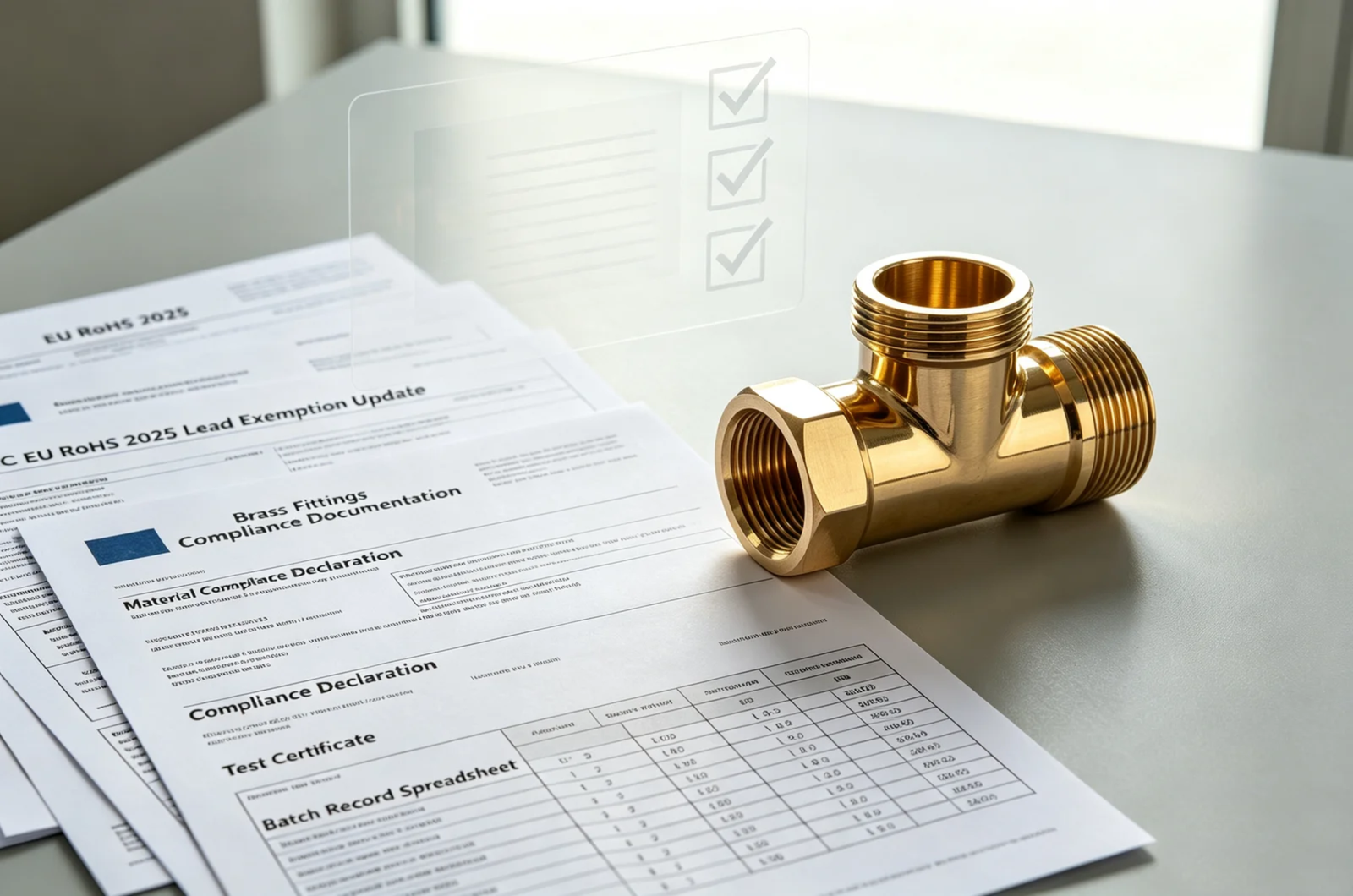
I am not writing this as legal advice. I am writing from the perspective of a brass fittings manufacturer that deals with brass bar selection, lead-content questions, batch records, and customer compliance documents every week. The practical issue is simple: buyers need stronger procurement controls before the rules create commercial risk.
What Do EU RoHS 2025 Lead Exemption Updates Mean For Brass Fittings Buyers?
Many buyers see EU RoHS 2025 lead exemption updates and immediately ask, “Are my brass fittings still compliant?” That question matters, but it is too broad. If the answer is based only on a supplier’s old declaration, the buyer may miss material, batch, or product-scope problems.
EU RoHS 2025 lead exemption updates mean buyers should treat compliance as a product-and-batch-specific review, not a general supplier promise. The key checks are brass composition, applicable exemption status, product scope, declaration date, batch traceability, and whether the fitting’s end application falls inside RoHS-controlled electrical or electronic equipment.
The biggest misunderstanding I see is that buyers often treat “RoHS compliant” as a fixed label. In real procurement, it is more like a chain of evidence. Each link needs to match the goods being shipped.
RoHS Scope Comes Before Any Exemption Discussion
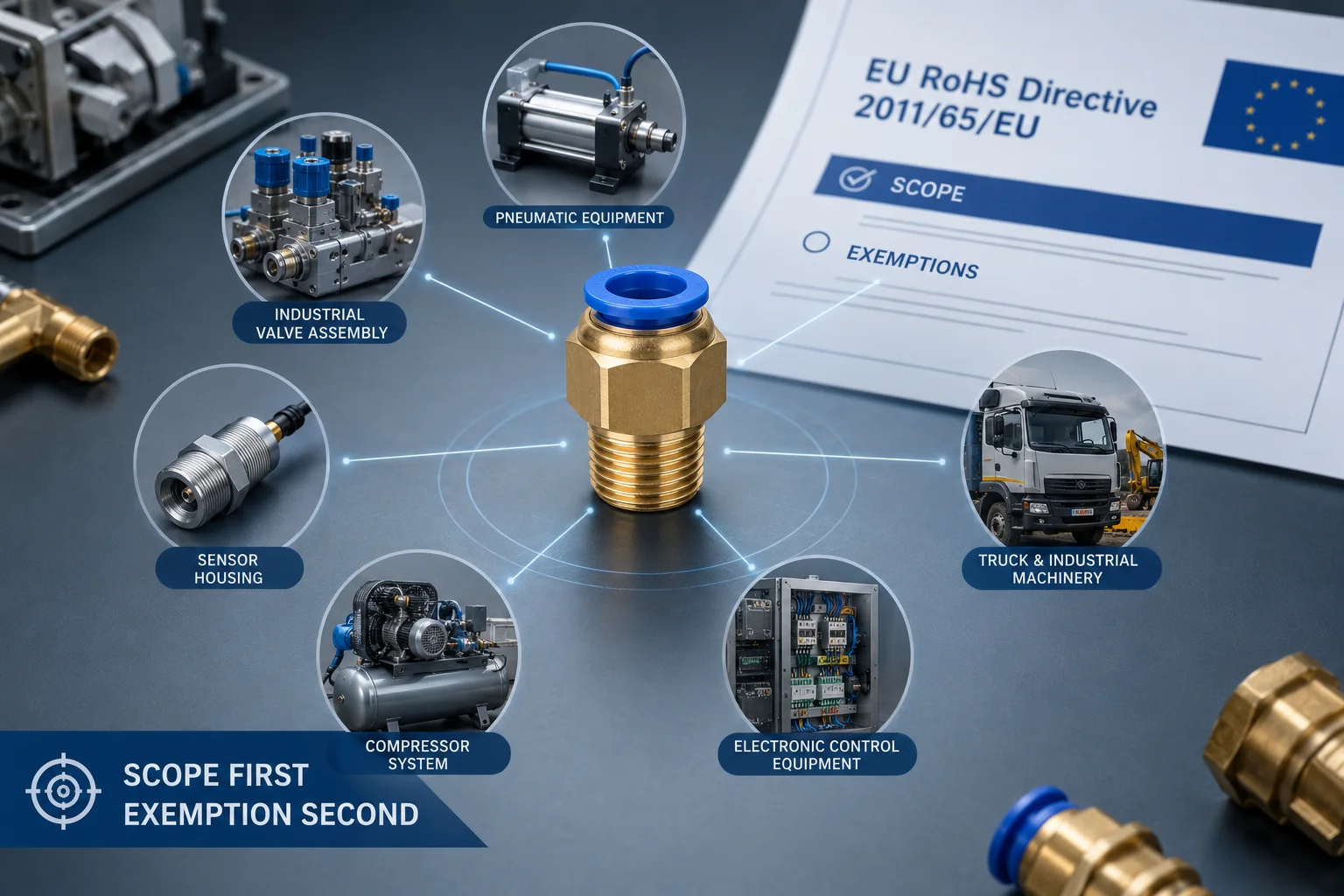
RoHS applies to certain electrical and electronic equipment, often called EEE.[^2] Brass fittings may be used in many industries, including:
- Pneumatic systems
- Hydraulic systems
- Truck and brake-related systems
- Industrial equipment
- Sensors, valves, compressors, and assemblies
- General hardware distribution
Some applications may be linked to equipment that falls under RoHS. Others may not.[^3] That is why I always recommend that buyers confirm the actual application before making a conclusion.
A brass fitting is not automatically inside or outside RoHS scope. The buyer must verify the end use, product category, and official EU guidance.
This is also why a manufacturer should not casually say, “All our brass fittings are RoHS compliant for Europe.” That statement may sound convenient, but it can be too broad. A responsible supplier should explain the material, the declaration scope, and the limits of the statement.
Lead In Brass Is A Technical Issue, Not Only A Legal Issue
Lead is used in many brass materials because it improves machinability.[^4] In practical factory terms, this affects:
- CNC turning efficiency
- Thread finish
- Tool wear
- Dimensional stability
- Surface quality
- Cost control
- Mass-production consistency
When buyers ask for low-lead brass or alternative materials, the request is reasonable. However, it should be evaluated technically. A material change may influence production speed, sealing performance, thread quality, and final cost.[^5]
Here is a simplified comparison:
| Material Direction | Possible Benefit | Possible Concern | Buyer Action |
|---|---|---|---|
| Standard leaded brass | Stable machining and competitive cost | Lead exemption reliance may be needed | Check exemption scope and documentation |
| Low-lead brass | Lower lead content | Higher machining cost and process adjustment | Request sample testing and price review |
| Lead-free alternative | Stronger environmental positioning | May affect strength, sealing, or supply stability | Validate performance before bulk orders |
| Stainless steel alternative | High corrosion resistance | Higher cost and different machining behavior | Compare application requirements |
At Yaochong, when customers ask about lead content, I do not treat it as a document-only question. I look at the brass grade, supplier certificate, machining requirement, pressure requirement, and whether the customer needs supporting test reports or material declarations. That approach is slower than sending a template PDF, but it is much safer.
Why Are EU RoHS 2025 Lead Exemption Updates Not Just A Declaration Issue?
Some importers believe a fresh RoHS declaration solves everything. That belief is risky. A declaration can be useful, but only if it is specific, current, and connected to the actual products[^6]. Otherwise, buyers may hold documents that do not protect their inventory.
EU RoHS 2025 lead exemption updates are not just a declaration issue because the real risk sits in the gap between the document and the goods. Buyers must confirm whether the declaration covers the exact fitting type, material grade, lead content, batch number, shipment date, and application scope.
A RoHS declaration is like a passport. It only works when the identity matches. If the declaration says one product family, but the shipment contains mixed fittings from different brass grades, the buyer has a problem. If the document was issued before a relevant exemption change, the buyer also has a problem.
What A Useful RoHS Declaration Should Show
A practical RoHS document should not be vague. Buyers should ask whether it includes:
- Supplier name and address
- Product name or product series
- Part numbers or drawing references
- Material description
- Declaration standard or directive reference
- Relevant exemption reference, if used
- Issue date
- Authorized signature
- Validity or review control
- Clear statement of document scope
Any specific RoHS exemption number, expiry date, renewal status, or conclusion about whether a fitting is covered should be verified against official EU sources[^7] and the buyer’s actual application. A supplier can support documentation, but the buyer should not use a supplier email as the only compliance basis.
Common Document Weaknesses I See
From the factory side, I have seen many document requests that are too broad. For example, a customer may ask, “Please send RoHS for all brass fittings.” That request sounds efficient, but it can create confusion.
Common weaknesses include:
- The declaration covers “brass parts” but not the actual fittings ordered.
- The document has no part numbers.
- The declaration date is old.
- The material grade is missing.
- The supplier uses one declaration for multiple factories or subcontractors.
- The declaration does not mention whether an exemption is relied upon.
- The shipment batch has no connection to the document.
- The buyer stores the PDF but cannot connect it to purchase orders.
For brass fittings, this matters because distributors often carry many similar items: straight couplings, elbows, tees, reducers, plugs, DOT fittings, NPT fittings, and custom parts. If the document does not identify the product clearly, the buyer may struggle during customer audits.
Declaration Control Should Be Part Of Procurement
I believe compliance documents should be managed like technical specifications. They should not sit in a random email folder. A buyer should connect each document to the supplier, item code, drawing, batch, and purchase order.
A simple control table can help:
| Control Item | Why It Matters | Practical Check |
|---|---|---|
| Product scope | Prevents wrong-document use | Match declaration to item code or drawing |
| Material grade | Confirms composition basis | Compare with material certificate |
| Batch number | Links paper to shipment | Match carton label, invoice, and inspection record |
| Issue date | Avoids outdated statements | Review after regulatory updates |
| Exemption reference | Shows compliance basis | Verify through official EU sources |
| Application | Confirms RoHS relevance | Check end-use category with compliance team |
I have learned that buyers who manage this early face fewer urgent problems later. The goal is not to collect more paperwork for its own sake. The goal is to make sure the paperwork actually proves something.
How Should Buyers Check Material Composition Under EU RoHS 2025 Lead Exemption Updates?
Lead-content concerns become serious when the buyer cannot prove what material was used. A supplier may say the fitting is made from H59, H62, CW617N, C36000, or another brass grade. However, the buyer needs evidence, not only a product description.
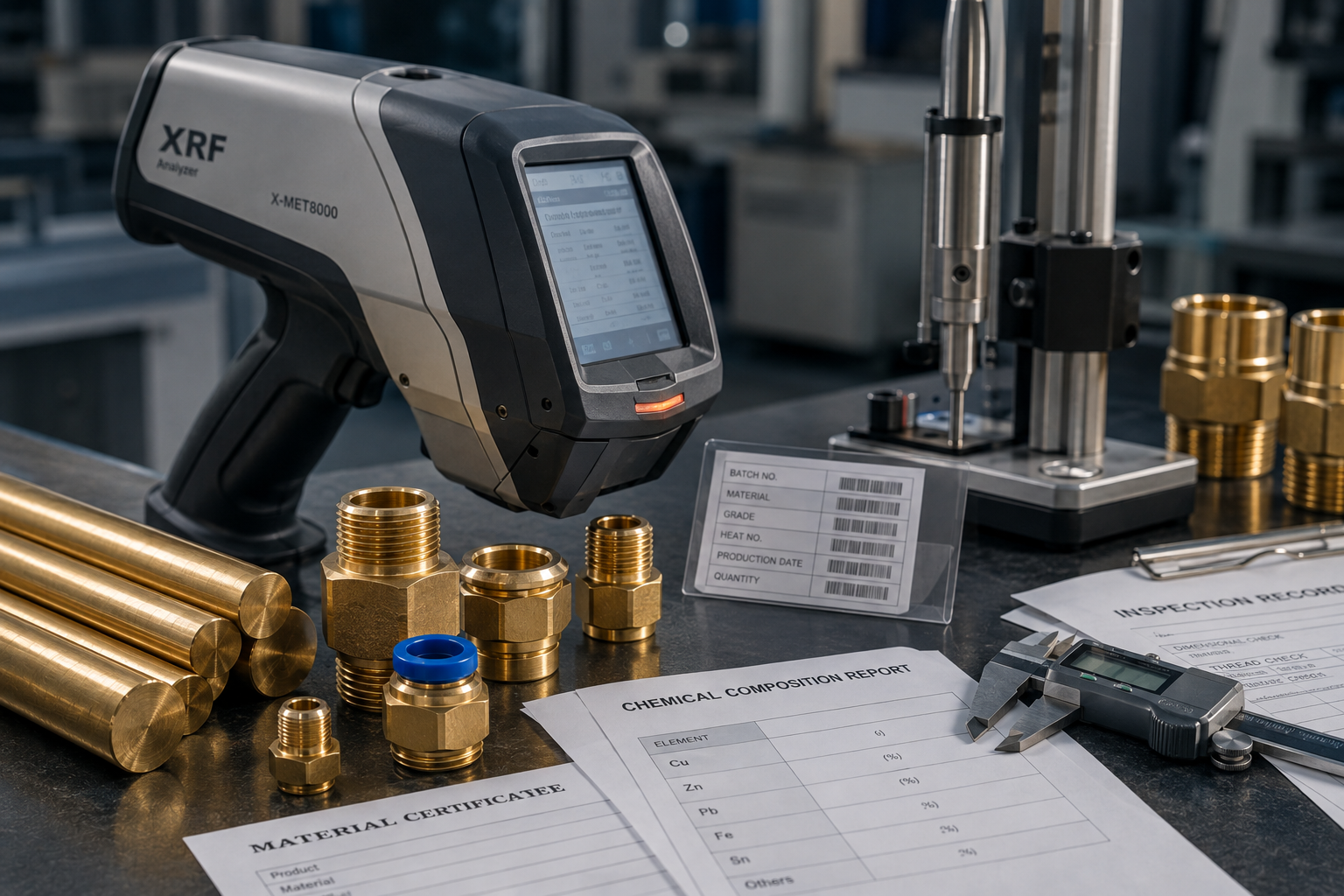
Under EU RoHS 2025 lead exemption updates, buyers should check material composition through supplier material declarations, brass bar certificates, incoming inspection records, or third-party test reports[^8] where needed. They should also confirm that these records are linked to the shipped batch, not just to a general material category.
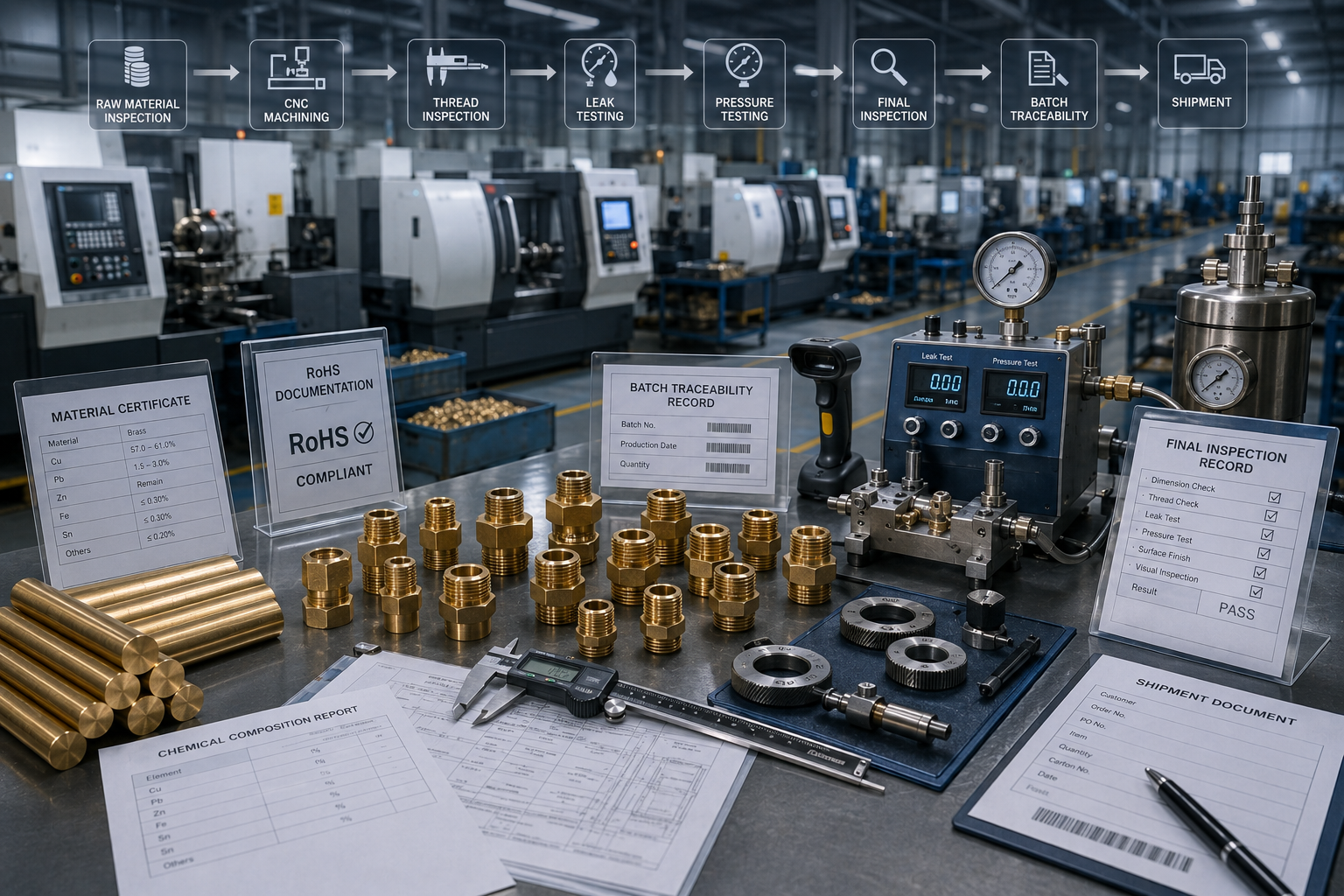
Material control starts before machining. In our factory, the process begins when brass bars arrive. The incoming material is not just stored and used. It should be checked, recorded, and linked to future production. This is where many compliance risks can be reduced.
What Buyers Can Request From Suppliers
A buyer does not always need every document for every small order. However, for European distribution and higher-risk applications, I recommend asking for a clear document package.
Useful records may include:
- Material supplier certificate
- Chemical composition report
- Supplier material declaration
- Batch production record
- Internal inspection record
- Third-party test report, if required
- RoHS declaration with product scope
- Packing list or invoice showing batch link
- Drawing or specification reference
The exact package depends on the customer, application, and risk level. A large distributor may need stronger controls than a small one-time buyer. However, both should avoid accepting a vague “compliant” statement without traceability.
Why Batch Consistency Matters
Brass fittings are often produced in large quantities. A single purchase order may include many SKUs and several production batches. If a supplier mixes materials, buys from unstable sources, or uses subcontracted production without control, the buyer may receive inconsistent parts.
Batch consistency affects both compliance and performance:[^9]
- Different lead levels may affect RoHS review.
- Different brass grades may affect torque strength.
- Thread quality may vary.
- Sealing performance may change.
- Corrosion resistance may not be consistent.
- Customer returns may increase.
At Yaochong, we use incoming material inspection for H59/H62 brass bars, batch certificate checking, and production traceability from raw material input to finished product delivery. We also conduct process sampling and final AQL inspection. These controls do not magically remove all regulatory risk, but they create a stronger evidence chain.
Material Change Requires Technical Validation
Some buyers respond to RoHS lead exemption concerns by immediately asking for low-lead or lead-free brass. That may be the right direction in some cases. However, it should not be done blindly.
Before switching materials, buyers should confirm:
-
Thread precision
The new material must support stable threading and gauge control. -
Air tightness
Fittings should pass leak testing under the agreed pressure condition. -
Pressure resistance
The material must fit the application. In our production, many products undergo 500 PSI pressure resistance testing, but the buyer must confirm the required test level for their use. -
Machining stability
Low-lead materials can increase tool wear or cycle time.[^10] -
Surface treatment compatibility
The new material may respond differently to cleaning or plating. -
Cost and lead time
Material availability can affect MOQ, price, and delivery.
A material strategy should balance compliance risk, performance, cost, and customer expectations. That is why I prefer early technical discussion instead of last-minute material replacement.
How Can Importers Reduce Inventory Risk Under RoHS Lead Exemption Updates?
Inventory risk is one of the most overlooked parts of RoHS planning. A buyer may purchase fittings today, store them for six months, and sell them after a regulatory interpretation or exemption status changes. That timeline can create problems if the buyer has no review process.
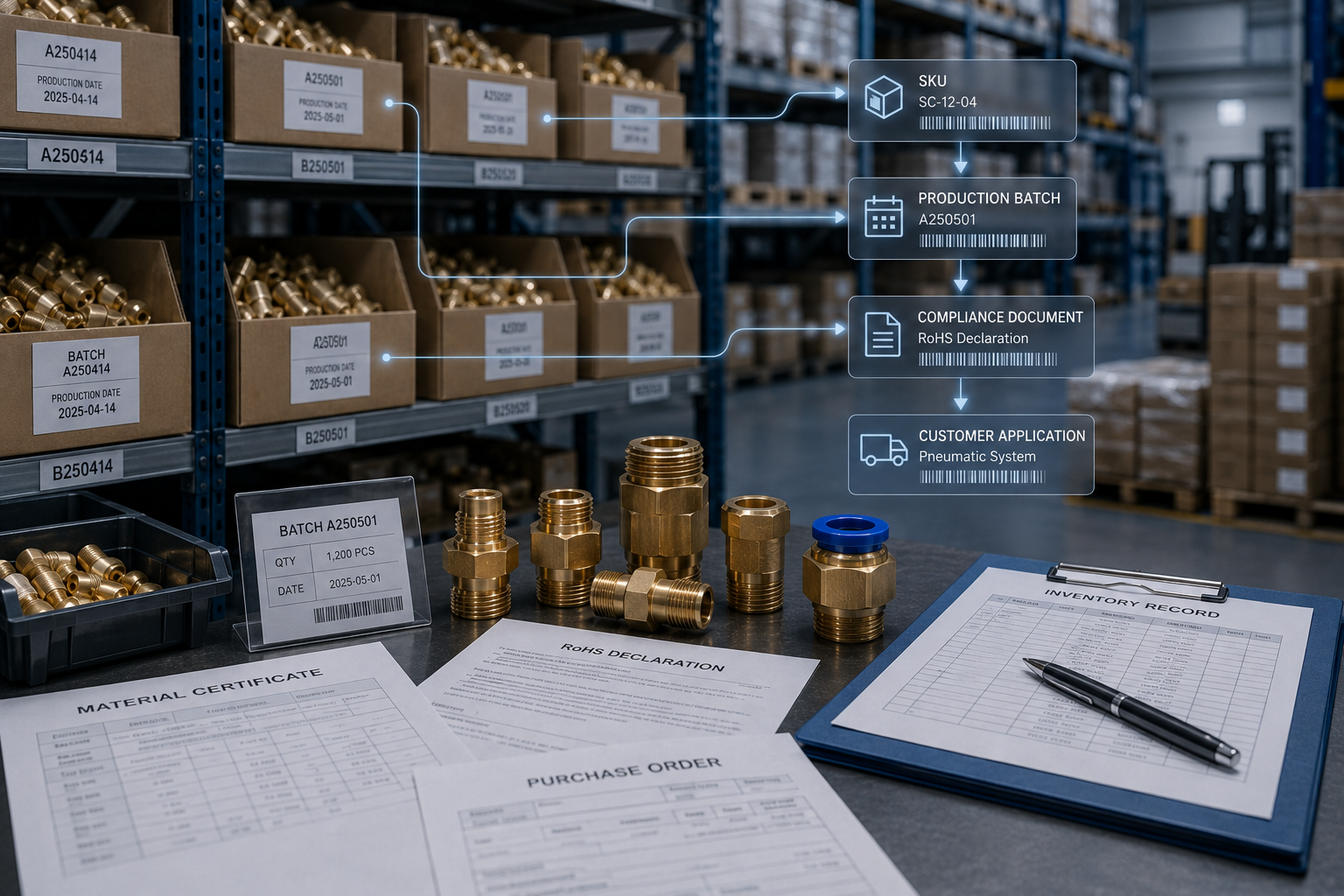
Importers can reduce inventory risk under RoHS lead exemption updates by segmenting stock by product, batch, document date, and customer application.[^11] They should avoid buying large quantities based only on old declarations and should review slow-moving inventory before future EU sales commitments.
The procurement question is not only, “Can I buy this fitting?” The better question is, “Can I still prove the compliance basis when I sell this fitting later?” That question changes how buyers should manage stock.
The Hidden Risk Of Old Stock
Many distributors keep safety stock. That makes sense because customers expect fast delivery. However, old stock can create compliance issues when documents are outdated or incomplete.
The risk increases when:
- Stock was purchased under an old understanding of exemptions.
- The declaration does not show an issue date.
- The supplier cannot identify the production batch.
- The buyer mixes old and new inventory.
- The same item code has multiple material versions.
- Customer applications changed after purchase.
- Sales teams promise compliance without checking documents.
For example, a distributor may have brass elbows from three suppliers under one internal item code. If a customer asks for RoHS documentation, the distributor must know which batch will ship. If the warehouse cannot separate batches, the document may not match the goods.
Practical Inventory Controls
A good inventory plan does not need to be complicated. It needs to be consistent.
I suggest buyers use these controls:
-
Separate stock by batch
- Keep batch labels visible.
- Avoid mixing old and new production lots.
-
Link documents to item codes
- Store RoHS declarations by part number.
- Include material records when available.
-
Review slow-moving items
- Check whether old declarations need renewal.
- Confirm whether the customer still accepts the compliance basis.
-
Create a high-risk SKU list
- Include fittings sold into EEE-related applications.
- Include items relying on lead-related exemptions.
-
Avoid overstocking uncertain items
- Use smaller rolling orders where possible.
- Ask suppliers about flexible MOQs and lead time.
-
Train sales and warehouse teams
- Sales should not promise compliance without checking.
- Warehouse teams should not substitute batches without approval.
Procurement Strategy For 2025 And Beyond
The EU RoHS 2025 lead exemption updates should push buyers to review supplier strategy. The cheapest supplier may not be the lowest-risk supplier if material control and documents are weak.
A stronger supplier review should include:
| Supplier Review Area | Good Sign | Warning Sign |
|---|---|---|
| Material sourcing | Stable brass bar suppliers and certificates | No material records |
| Production control | In-house machining and batch tracking | Unknown subcontracting |
| Testing | Thread gauges, leak tests, pressure checks | Only visual inspection |
| Documents | Product-specific declarations | Generic PDF for all items |
| Traceability | Batch records from material to shipment | No link between goods and paperwork |
| Communication | Fast technical response | Sales-only answers |
Yaochong is located near Ningbo Port and supports standard stock, flexible MOQs, and OEM/ODM production. I mention this not as a hard sales pitch, but because delivery flexibility can reduce compliance pressure. Buyers who can place controlled rolling orders may avoid holding too much uncertain inventory.
What Should A Supplier Review Include For EU RoHS 2025 Lead Exemption Updates?
A weak supplier review focuses only on price and delivery. That may work for simple purchasing, but it is not enough when RoHS lead exemption questions affect future sales. Buyers need a review process that connects quality, compliance, and traceability.
A supplier review for EU RoHS 2025 lead exemption updates should include material source control, chemical composition evidence, batch traceability, RoHS document scope, inspection records, change notification rules, and the supplier’s ability to support technical questions without making unsupported legal claims.
A good supplier does not need to pretend that every answer is simple. In fact, I trust suppliers more when they explain boundaries clearly. Regulatory scope depends on the buyer’s application, official EU rules, and current exemption status. A manufacturer should support the evidence chain, not act like a regulatory authority.
Questions I Would Ask A Brass Fittings Supplier
If I were auditing a supplier for European distribution, I would ask direct questions like these:
- Which brass grades do you use for this fitting?
- Can you provide material certificates for the shipped batch?
- Do you perform incoming brass bar inspection?
- Can you link the finished fittings to raw material batches?
- Does your RoHS declaration cover this exact item number?
- Does the declaration rely on any lead exemption?
- When was the declaration issued?
- How do you control mixed-material production?
- What happens if a material source changes?
- Can you provide samples for third-party testing if required?
- Do you keep inspection records for thread and air tightness?
- Can you support OEM packaging with batch identification?
These questions are practical. They reveal whether a supplier has real control or only sales language.
What Manufacturers Can Actually Control
Manufacturers cannot control every legal interpretation. However, we can control many production-side factors.
At Yaochong, the controllable points include:
-
Material selection
- We select brass material according to drawings, customer requirements, and application needs.
-
Incoming material checks
- We verify brass bar certificates and conduct incoming inspection.
-
Precision machining
- We use CNC lathes, thread rolling machines, and tapping equipment to control dimensions.
-
Thread inspection
- We use thread gauges to confirm thread quality.
-
Air tightness testing
- We test sealing performance according to product requirements.
-
Pressure testing
- We support pressure resistance checks, including 500 PSI testing for applicable products.
-
Batch records
- We maintain traceability from material input to finished delivery.
-
Final inspection
- We use AQL sampling before warehousing.
-
Document support
- We help customers prepare product-specific records where the scope is clear.
These steps do not mean a supplier can say, “No RoHS risk exists.” That would be too absolute. They mean the supplier can provide a stronger factual basis for the buyer’s compliance review.
Red Flags Buyers Should Not Ignore
Buyers should be careful when a supplier:
- Sends a RoHS document with no product names.
- Refuses to discuss material grade.
- Cannot provide any material certificate.
- Gives different answers from sales and engineering teams.
- Uses “RoHS” and “REACH” as if they are the same.
- Claims all products are compliant without application review.
- Cannot identify production batches.
- Offers very low prices with no quality documentation.
- Changes material without notification.
RoHS is different from REACH, and both are different from drinking-water low-lead rules.[^12] These standards may all involve chemical restrictions, but they are not interchangeable. A supplier should understand the difference or be willing to verify it carefully.
Frequently Asked Questions
Are all brass fittings covered by EU RoHS?
No. Brass fittings are not automatically covered or excluded. RoHS scope depends on the product’s end use, especially whether it becomes part of electrical or electronic equipment. Buyers should verify the application, product category, and official EU guidance before making a compliance conclusion.
Is a general RoHS declaration enough for brass fittings?
A general declaration is usually not enough for serious procurement control. Buyers should confirm that the declaration matches the exact fitting type, part number, material grade, batch, issue date, and exemption basis. The document should be connected to the actual shipped goods.
Does low-lead brass solve all RoHS lead exemption concerns?
Low-lead brass may reduce risk, but it does not automatically solve every compliance question. Buyers still need to confirm RoHS scope, material composition, product performance, document validity, and application requirements. Low-lead material can also affect machining cost, thread quality, and delivery stability.
Should buyers test every brass fitting batch for lead content?
Not always. Testing frequency depends on risk level, supplier reliability, application, and customer requirements. Many buyers combine supplier material certificates, incoming inspection records, batch traceability, and periodic third-party testing. High-risk or EEE-related applications may justify stronger testing controls.
How often should RoHS documents be reviewed?
Buyers should review RoHS documents whenever regulations change, exemptions are updated, suppliers change materials, product designs change, or old inventory is sold into new applications. For active European distribution, an annual review plus update-triggered reviews is a practical starting point.
Conclusion
EU RoHS 2025 lead exemption updates should push brass fittings buyers to improve procurement control, not just collect another PDF. The key is to connect material composition, product scope, batch traceability, declaration dates, and actual application. From my manufacturer-side experience, the safest path is early technical communication and clear documentation boundaries. If you need brass fittings with stable production records, material traceability, and practical compliance document support, contact Yaochong to review your product list and sourcing plan.
[^1]: "EU Commission Adopts Key RoHS Lead Exemption Changes", https://blog.sourceintelligence.com/eu-commission-adopts-key-rohs-lead-exemption-changes?hs_amp=true. Official European Commission or EUR-Lex materials on RoHS Annex III exemptions support that lead-related exemptions for copper alloys are time-limited and subject to review or renewal, providing the regulatory context for buyer concern in 2025; however, such sources establish the legal timetable rather than proving market uncertainty among brass fittings buyers. Evidence role: historical_context; source type: government. Supports: The source should document the EU RoHS exemption framework for lead in copper alloys or related materials and show the timing or renewal status relevant to 2025.. Scope note: Contextual support for the regulatory background, not direct proof of buyer uncertainty. [^2]: "EU WEEE_RoHS", https://www.trade.gov/eu-weeerohs. Directive 2011/65/EU defines the RoHS regime as applying to electrical and electronic equipment and sets out the relevant product-scope framework, supporting the statement that RoHS is directed at specified EEE categories. Evidence role: definition; source type: government. Supports: The source should define the scope of RoHS and the meaning of electrical and electronic equipment under EU law.. [^3]: "RoHS", https://en.wikipedia.org/wiki/RoHS. EU RoHS scope guidance supports that restrictions are assessed in relation to covered electrical and electronic equipment, so a component’s RoHS relevance depends on its use in such equipment; this is contextual support because the guidance may not discuss brass fittings specifically. Evidence role: general_support; source type: government. Supports: The source should explain that RoHS obligations are tied to EEE scope and that component relevance depends on incorporation into covered equipment.. Scope note: Contextual support for component-scope reasoning, not a brass-fitting-specific ruling. [^4]: "Machinability Evaluation of Low-Lead Brass Alloys", https://www.sciencedirect.com/science/article/pii/S2351978920301037. Materials-engineering literature on free-cutting brass reports that lead additions improve machinability by promoting chip breakage and reducing cutting difficulty, supporting the article’s explanation for the industrial use of leaded brass. Evidence role: mechanism; source type: paper. Supports: The source should explain how lead in brass improves machinability, such as by improving chip formation or reducing tool friction.. [^5]: "Chemical composition of new copper alloys for machining ...", https://www.academia.edu/111583205/Chemical_composition_of_new_copper_alloys_for_machining_and_its_effect_on_their_susceptibility_to_corrosion_cracking. Comparative studies of leaded and lead-free copper alloys support that alloy composition can change machinability, tool wear, and surface finish, which provides a technical basis for expecting production and cost effects after material substitution; the source may not directly evaluate sealing performance in every fitting design. Evidence role: mechanism; source type: paper. Supports: The source should show that brass alloy composition affects machining behavior, tool wear, surface quality, or mechanical properties.. Scope note: Direct for machinability-related effects, contextual for sealing performance and final product cost. [^6]: "RoHS Technical File Documentation Services", https://www.intertek.com/assuris/restricted-substances/regulatory/rohs-technical-file-documentation/. EN IEC 63000, the harmonised standard for RoHS technical documentation, supports the need for product-linked and current documentation when assessing restricted substances; this supports the article’s documentation-control principle rather than prescribing the exact wording of every supplier declaration. Evidence role: general_support; source type: institution. Supports: The source should describe the documentation approach used to assess restricted substances in electrical and electronic products, including product identification and evidence from suppliers or testing.. Scope note: Contextual support for documentation control, not a direct rule for every brass fitting transaction. [^7]: "explanatory memorandum - EUR-Lex", https://eur-lex.europa.eu/legal-content/EN/TXT/HTML/?uri=PI_COM:C(2025)5939. EUR-Lex and European Commission RoHS exemption materials provide the authoritative text for Annex III exemption entries, conditions, and validity periods, supporting the need to verify exemption references and dates against official EU sources. Evidence role: general_support; source type: government. Supports: The source should show that RoHS exemptions are formally listed in EU legal acts or Commission materials and include exemption conditions and validity periods.. [^8]: "EN IEC 63000:2018: RoHS Technical Documentation Guide | Regilient", https://www.regilient.ai/blog/en-iec-63000-2018-rohs-technical-documentation. RoHS technical-documentation standards such as EN IEC 63000 recognize supplier-provided material information and analytical testing as evidence used to assess restricted substances, supporting the article’s list of composition-checking records. Evidence role: general_support; source type: institution. Supports: The source should support the use of supplier documentation, material information, and test reports as evidence in restricted-substance assessment.. [^9]: "(PDF) Investigation of Mechanical Properties and Microstructure ...", https://www.academia.edu/69958409/Investigation_of_Mechanical_Properties_and_Microstructure_of_Brass_Alloys_Obtained_from_Recycled_Copper_and_Zinc_Metals. Quality-management standards requiring identification and traceability of outputs where necessary for conformity support the article’s claim that batch consistency is relevant to compliance and performance control; the standard establishes a general control principle rather than testing brass fittings specifically. Evidence role: general_support; source type: institution. Supports: The source should support the quality-management principle that traceability and control of production batches help maintain product conformity, or that alloy composition affects properties.. Scope note: General quality-management support, not direct experimental proof for each listed fitting performance attribute. [^10]: "Advanced trends in design of lead-free alternative for ...", https://www.academia.edu/22452862/Advanced_trends_in_design_of_lead_free_alternative_for_traditional_free_machining_brasses. Machining studies comparing leaded and lead-free brasses report differences in tool wear, cutting forces, chip formation, or machining efficiency, supporting the claim that low-lead substitutions can increase tool wear or cycle time. Evidence role: mechanism; source type: paper. Supports: The source should compare machinability or tool-wear outcomes between leaded and low-lead or lead-free brass alloys.. [^11]: "EU RoHS Directive: Substances, Exemptions and CE Marking", https://www.regilient.ai/blog/rohs-compliance-consulting-and-software-solutions. EU product-compliance guidance and the RoHS framework support that importers must ensure conformity and maintain appropriate documentation and traceability, providing a legal rationale for inventory segmentation by batch and document status; the source does not prescribe the article’s exact inventory-control table. Evidence role: general_support; source type: government. Supports: The source should show that EU product-compliance frameworks place obligations on importers regarding conformity, identification, traceability, and documentation.. Scope note: Contextual legal support for traceability-based controls, not direct validation of the specific inventory method. [^12]: "Use of Lead Free Pipes, Fittings, Fixtures, Solder, and Flux ...", https://www.epa.gov/sdwa/use-lead-free-pipes-fittings-fixtures-solder-and-flux-drinking-water. Official EU materials define RoHS as a restriction on hazardous substances in electrical and electronic equipment, while ECHA describes REACH as a broader chemicals registration and risk-management regime; drinking-water lead rules are addressed under separate potable-water legislation, supporting the article’s distinction among these frameworks. Evidence role: definition; source type: government. Supports: The source should define RoHS and REACH separately and, where relevant, define drinking-water lead requirements for plumbing products..