

(# How Section 232 Copper Tariffs Impact Brass Fittings Importers in 2026?
Section 232 ![How Section 232 Copper Tariffs Impact Brass Fittings Importers in 2026]copper tariffs can create real planning pressure for brass fittings importers in 2026.[^1] I see many buyers asking one urgent question: “How much will my price increase?” That question is understandable, but it can hide bigger risks. A better approach is to model landed cost, supply timing, inventory exposure, and supplier reliability together.
Section 232 copper tariffs may impact brass fittings importers by increasing tariff exposure, shortening quotation validity, raising landed costs, and complicating inventory planning. The impact will not be the same for every fitting. Importers should verify duty applicability with customs advisors, then use scenario-based pricing to protect margins and avoid stock disruption in 2026.

I have recently discussed tariffs, pricing validity, and lead-time pressure with North American brass fitting importers and DOT brake fitting buyers. Those conversations all point in the same direction: 2026 purchasing decisions should not depend on one fixed price sheet alone.
Why Do Section 232 Copper Tariffs Change Landed Cost for Brass Fittings Importers?
Tariffs create a problem when buyers only compare factory unit prices. That narrow view can make a quotation look safe when the real landed cost is still moving. If Section 232 copper tariffs apply to relevant products or inputs, importers may face margin pressure after the goods already ship.
Section 232 copper tariffs can change landed cost because importers must account for duty exposure, customs handling, freight, insurance, brokerage, inventory carrying cost, quotation validity, and margin protection.[^2] Buyers should not treat tariff pressure as a simple per-piece increase. They should recalculate full landed cost under multiple 2026 scenarios.
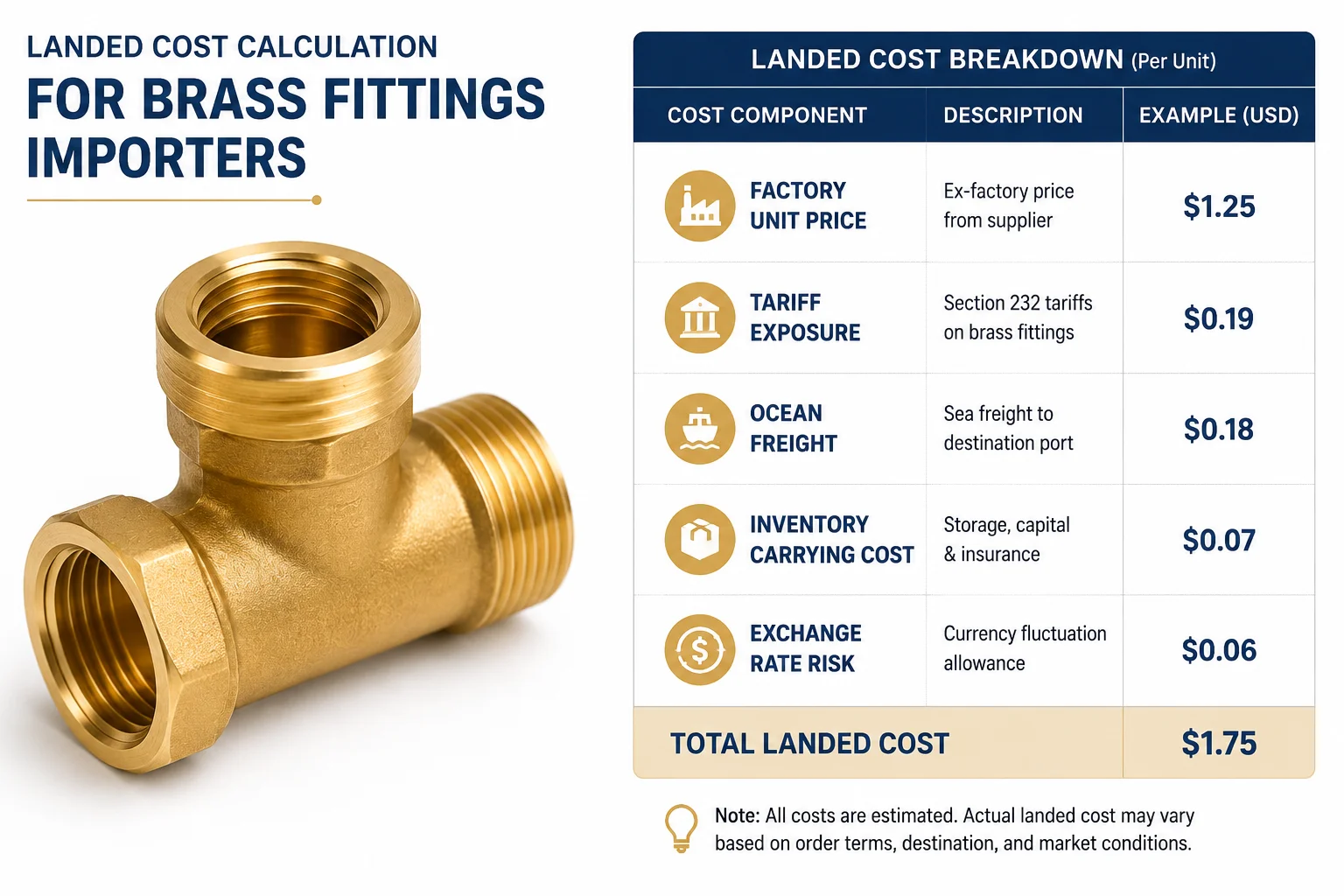
Landed cost is bigger than the supplier’s unit price
When I discuss quotations with importers, I often notice one common habit. Many buyers first ask, “Can you hold the same price?” That question matters, but it is only one layer. Brass fittings have material cost, machining cost, testing cost, packaging cost, export cost, freight cost, duty cost, and financing cost. A small change in any layer can affect the final margin.
A landed-cost review should include at least these items:
- Factory unit price
- Copper or brass raw material movement
- Tariff exposure, if applicable after customs review
- Ocean or air freight
- Customs brokerage and entry fees
- Insurance and inland delivery
- Inventory carrying cost
- Exchange rate risk
- Rework, claim, or return risk
- Margin buffer for distributors and wholesalers
> I am not a U.S. customs lawyer, so I do not advise importers to assume a duty rate or HTS treatment without professional review. Importers should verify classification, origin, and final duty applicability with their customs broker or trade advisor.
A simple landed-cost table helps buyers see the real risk
| Cost Item | Why It Matters in 2026 | Buyer Action |
|---|---|---|
| Factory price | May change with brass bar cost and production cost | Request price validity terms |
| [Tariff exposure | May vary by classification and scope](https://www.cbp.gov/trade/programs-administration/determining-duty-rates)[^3] | Confirm with customs broker |
| Freight | Can change quickly with port congestion or routing | Compare normal and urgent shipment costs |
| Inventory cost | Higher safety stock ties up cash | Calculate carrying cost monthly |
| Quality risk | Defects create hidden landed-cost loss | Review inspection and testing standards |
| Lead time | Delays can cause stockouts and emergency buying | Build reorder points earlier |
The margin issue is often delayed
A tariff-related cost increase does not always hurt on the day of purchase. It may hurt weeks later when goods arrive, duties are settled[^4], and the buyer realizes that the sales price has not changed. This delay is dangerous for truck parts wholesalers and DOT brake fitting distributors because they often sell into competitive channels.
For example, a distributor may quote a customer based on old stock cost. If the next container arrives at a higher landed cost, the distributor must choose between raising prices, accepting lower margin, or losing the customer. None of these options is ideal.
That is why I recommend a landed-cost worksheet for every major brass fitting category. The worksheet does not need to be complex. It only needs to show the real cost from factory to warehouse shelf. Once buyers see that number, they can decide whether to adjust prices, increase safety stock, renegotiate terms, or split orders by priority.
Will Section 232 Copper Tariffs Affect Every Brass Fitting the Same Way?
Many importers worry that every brass fitting will rise by the same percentage. That assumption can create bad decisions. Brass fittings differ by copper content, size, machining time, thread type, pressure requirement, testing method, and order quantity. These factors change how cost pressure moves through the supply chain.
Section 232 copper tariffs will not necessarily affect every brass fitting equally. The final impact may depend on product classification, copper content, brass grade, machining complexity, thread specification, DOT or FMVSS-related requirements, order volume, supplier terms, and whether the product falls within the applicable tariff scope after customs review.
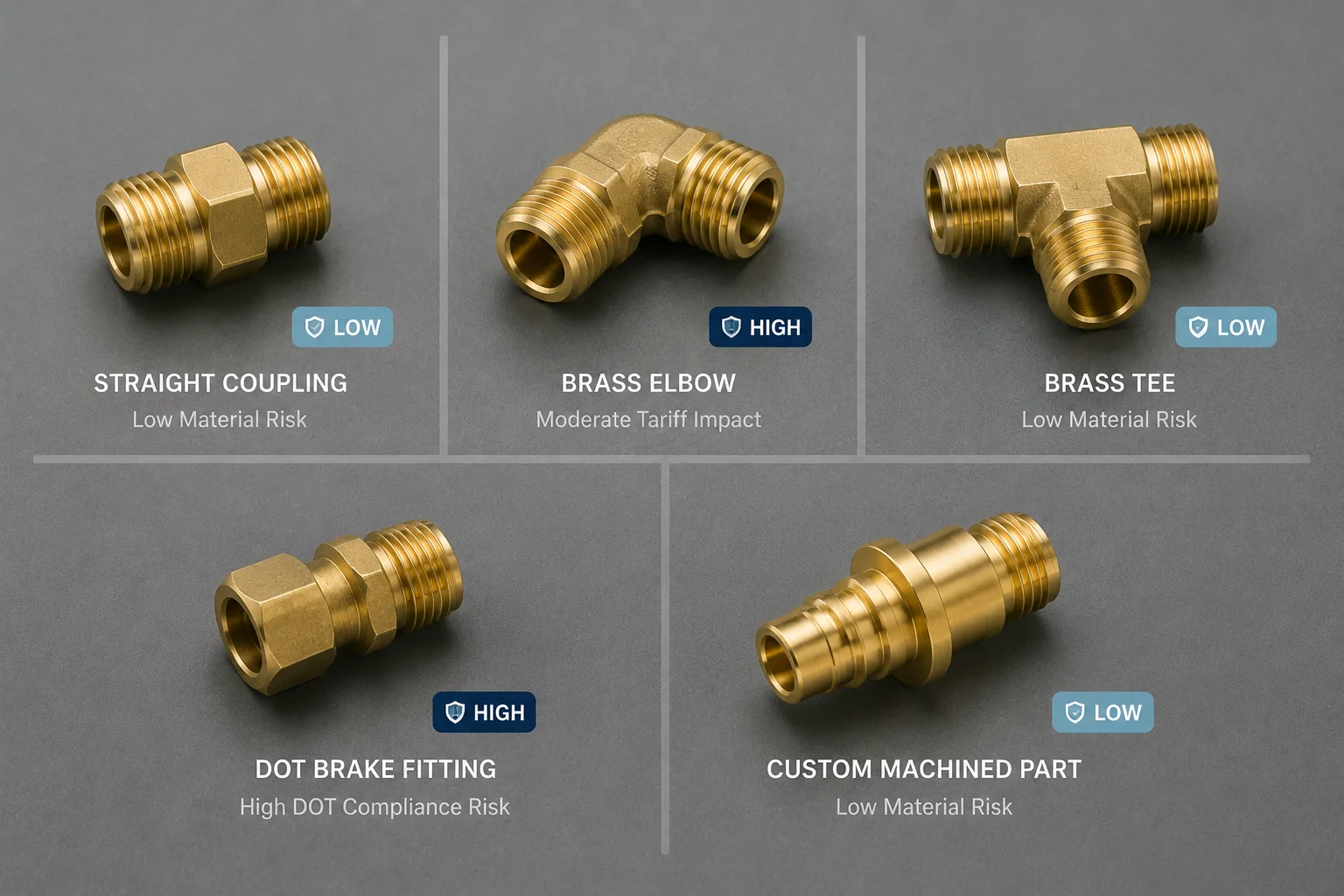
Brass fitting price is not only copper cost
Brass is a copper-zinc alloy, so copper cost matters.[^5] However, I would not reduce brass fitting pricing to copper alone. A simple straight coupling and a DOT push-in fitting do not carry the same production burden. A precision elbow with strict thread requirements may need more machining time, more inspection, and tighter process control.
The final price may reflect:
-
Raw material grade H59 and H62 brass bars may have different cost structures and mechanical performance considerations.[^6]
-
Part weight Heavier fittings use more material, so material movement has a stronger impact.
-
Machining complexity More turning, drilling, tapping, or forming steps increase processing cost.
-
Thread type and tolerance NPT threads, DOT-related threads, and custom specifications require accurate gauges and stable production control.[^7]
-
Surface treatment and cleaning Nickel plating, ultrasonic cleaning, and anti-corrosion requirements add cost and lead time.
-
Testing requirements Air tightness testing, pressure testing, thread inspection, and salt spray testing all protect quality, but they also require equipment and labor.[^8]
Product examples show why one percentage does not fit all
| Product Type | Main Cost Driver | Risk Under Tariff Pressure | Procurement Note |
|---|---|---|---|
| Straight brass coupling | Material weight and thread accuracy | Moderate material sensitivity | Good for volume pricing review |
| Brass elbow | Machining complexity and scrap control | Higher processing sensitivity | Check dimensional stability |
| Brass tee | Material use and multi-axis machining | Higher cost variability | Review MOQ and cycle time |
| DOT brass fitting | Compliance, sealing, testing | Quality risk if supplier is weak | Confirm FMVSS 106-related requirements |
| Custom brass fitting | Drawing, tooling, process setup | High quotation uncertainty | Request prototype and batch validation |
Quality requirements can outweigh small price savings
When buyers face tariff uncertainty, some immediately search for the lowest unit price. I understand the pressure. However, I have also seen that a low price can become expensive when thread precision, sealing performance, or delivery reliability fails.
For DOT brass fittings and brake-related components, the buyer usually cannot treat the fitting as a generic commodity.[^9] The product may need stable dimensions, reliable air tightness, pressure resistance, and proper documentation. If a cheaper source creates leakage claims or rejected shipments, the buyer loses more than the tariff savings.
This is especially important for North American truck parts distributors. Their customers expect replacement parts to fit correctly and perform consistently. If a fitting fails in the field, the distributor may face returns, customer complaints, and brand damage.
So, I suggest that importers group products into cost-risk categories:
- High material sensitivity: heavy fittings, large brass bodies, reducers
- High machining sensitivity: elbows, tees, custom shapes
- High compliance sensitivity: DOT fittings and brake system-related items
- High inventory sensitivity: fast-moving SKUs that must stay in stock
- High customer sensitivity: products sold under private label or brand programs
This grouping helps buyers negotiate intelligently. Instead of asking for one across-the-board discount, they can discuss product-specific pricing, MOQ, lead time, and safety stock plans.
How Should Importers Build 2026 Pricing Scenarios Around Section 232 Copper Tariffs?
A single fixed quotation can feel comfortable, but it may not survive real 2026 market conditions. If tariffs, copper costs, freight rates, or lead times change, buyers need a plan before the change happens. Otherwise, they may react too late and lose margin or stock availability.
Importers should build 2026 pricing scenarios around Section 232 copper tariffs by preparing at least four cases: a base case, a higher-cost case, a delayed-shipment case, and an urgent-replenishment case. Each case should include landed cost, selling price, margin, reorder timing, and supplier quotation validity.
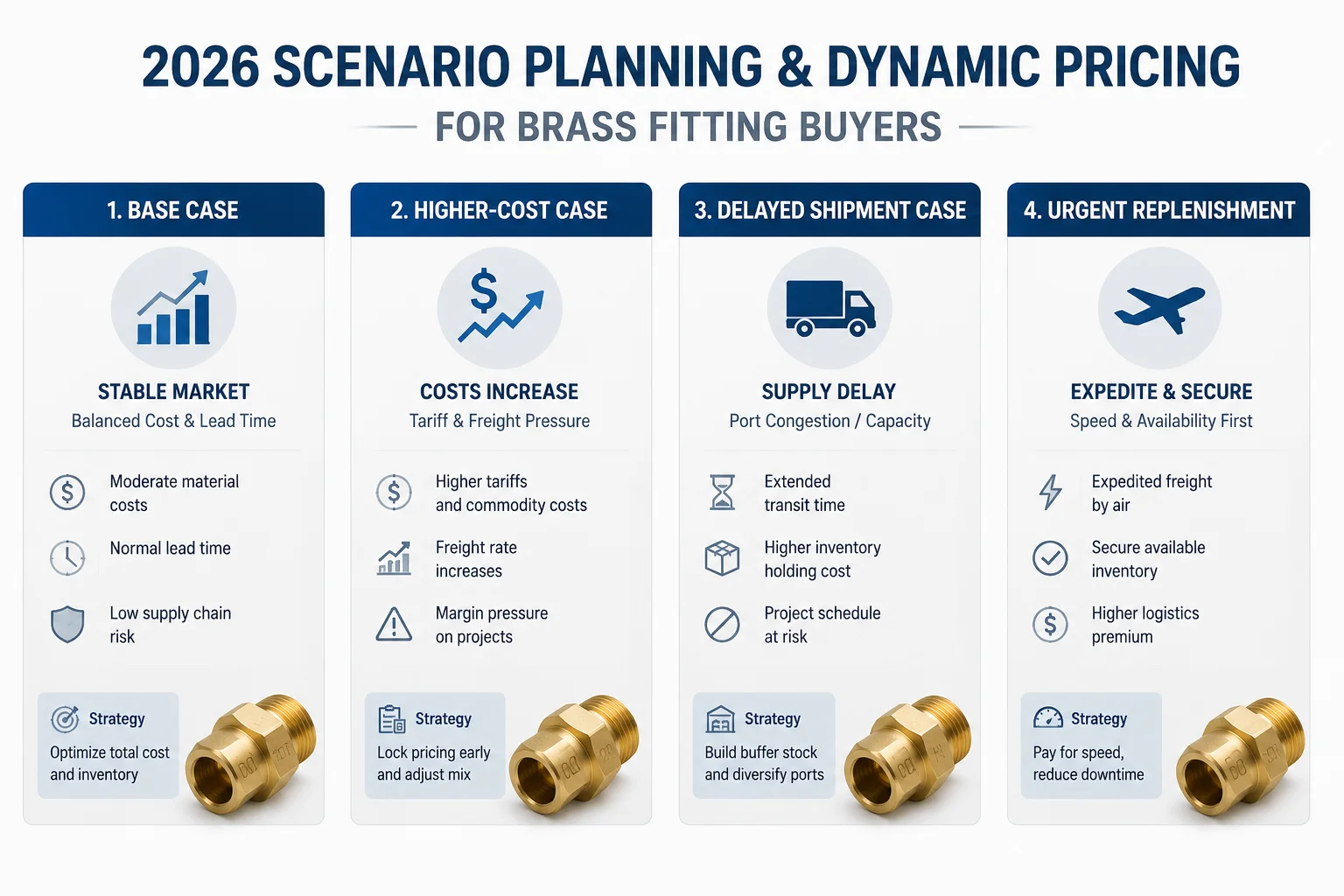
Scenario planning turns uncertainty into a buying system
I prefer scenario-based pricing because it gives buyers a practical decision map. It does not require anyone to predict copper prices or U.S. trade policy with certainty. Instead, it asks, “What will we do if this situation happens?”
For 2026, I would build four basic cases.
| Scenario | What It Means | Main Risk | Recommended Buyer Response |
|---|---|---|---|
| Base case | Current expected cost and lead time | Normal margin pressure | Maintain planned purchasing cycle |
| Higher-cost case | Material, tariff, or freight cost rises | Margin compression | Adjust selling price or MOQ strategy |
| Delayed-shipment case | Production or logistics takes longer | Stockout risk | Increase reorder lead time |
| Urgent-replenishment case | Buyer needs fast replacement stock | High freight and rush cost | Reserve safety stock for top SKUs |
The base case should not be too optimistic
Many buyers build the base case using today’s quote and today’s freight. That is a start, but it may be too optimistic if quotation validity is short. In recent conversations, I have seen more importers ask how long a price can be held. That question has become more important because brass raw material cost can move before a buyer confirms the purchase order.
A practical base case should include:
- Validity period of the quotation
- Expected production lead time
- Expected shipping time
- Current material cost reference
- Payment term and currency assumption
- Estimated customs and duty treatment after broker review
- Expected warehouse arrival date
The higher-cost case protects margin
The higher-cost case should answer one question: At what landed cost do we need to adjust our selling price? This is where importers protect profit before the order arrives.
For example, a distributor may set a margin floor. If landed cost rises above that floor, the sales team updates pricing for new orders. This rule prevents the company from selling new stock at old pricing.
The delayed-shipment case protects availability
Lead time pressure can be just as damaging as price pressure. If a buyer waits until stock is low, even a good factory price may not help. Production queues, customs delays, port congestion, and trucking delays can all affect the final arrival date.[^10]
For fast-moving brass fittings, buyers should set reorder points based on real lead time, not ideal lead time. If normal delivery takes 45 days but a delay case takes 70 days, the reorder point should reflect that risk.
The urgent case prevents panic buying
Urgent replenishment is usually expensive. Air freight, partial shipments, rush production, and emergency sourcing can destroy margin. I often advise buyers to identify their top 20% SKUs by sales volume and protect those first.
A simple urgent-stock plan may include:
- Safety stock for fast-moving DOT fittings
- Pre-approved reorder quantities
- Mixed-SKU MOQ agreements
- Reserved production slots during peak season
- Clear communication rules with the supplier
Scenario planning does not remove uncertainty. However, it prevents uncertainty from becoming chaos.
Can Switching Suppliers Reduce Section 232 Copper Tariffs Risk?
Supplier switching looks tempting when tariff risk rises. The problem is that a new supplier or new sourcing country may solve one cost issue while creating others. Importers still need to verify origin, quality systems, production capability, compliance requirements, and after-sales responsibility before making a change.
Switching suppliers may reduce some Section 232 copper tariffs risk, but it can also introduce origin compliance, quality, lead time, and documentation risks. Importers should not switch only for a lower price. They should compare total landed cost, product performance, supplier reliability, and customs guidance before changing sourcing plans.
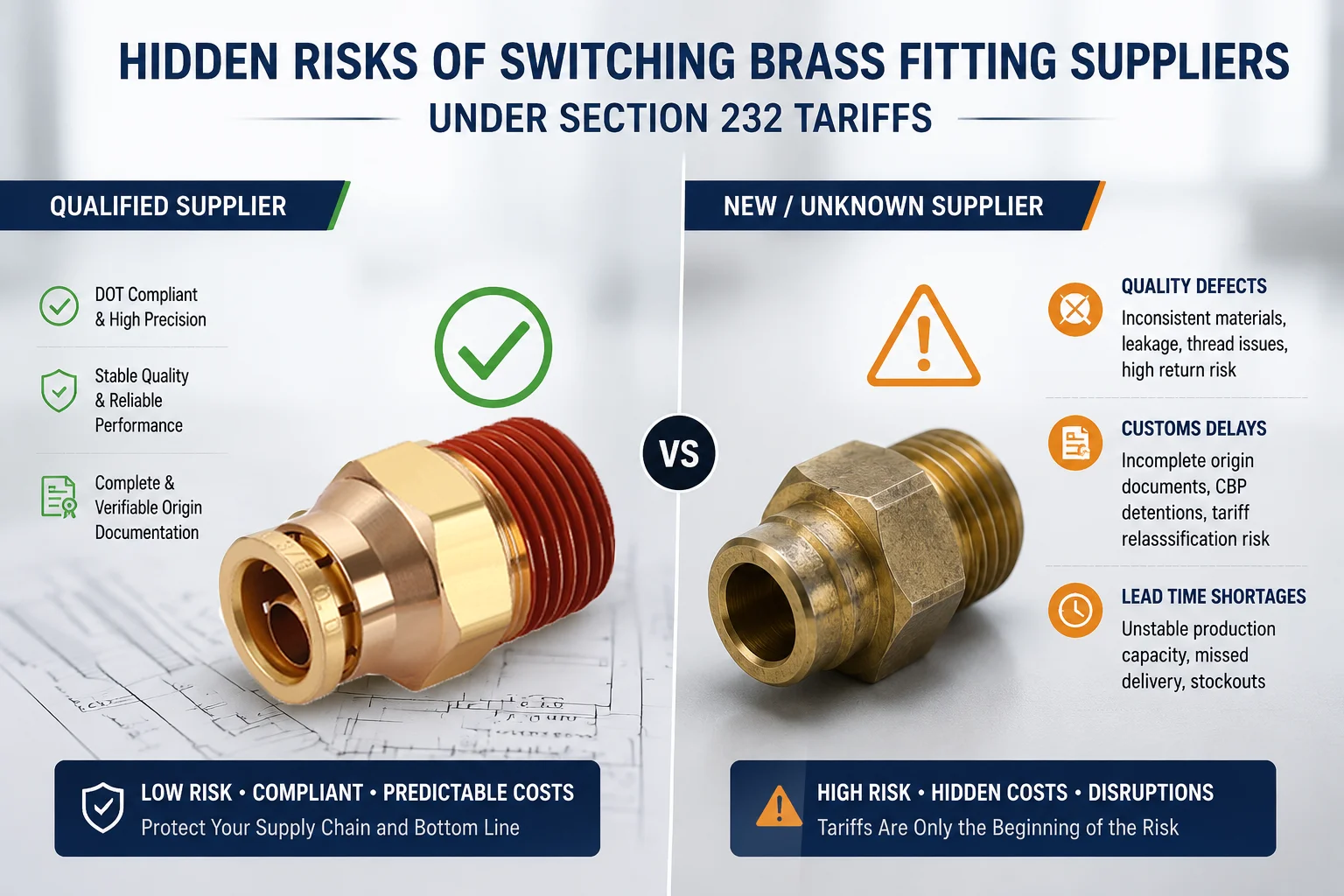
A cheaper source can create hidden costs
I understand why importers review alternative suppliers during tariff uncertainty. Procurement teams must protect margins. However, brass fittings are precision fluid connection parts. They are not only pieces of metal. They must seal properly, match threads correctly, resist corrosion, and perform under pressure.
A new supplier should be checked across several areas:
- Material control: Does the supplier inspect brass bar composition?
- Thread accuracy: Does the supplier use proper thread gauges?
- Pressure performance: Does the supplier test pressure resistance where required?
- Air tightness: Does the supplier test leakage risk?
- Production capacity: Can the supplier deliver stable volume?
- Traceability: Can the supplier trace batches from material to finished goods?
- Packaging: Can the supplier support private label or distributor packaging?
- After-sales support: Will the supplier respond quickly if there is a quality issue?
Origin and classification must be verified professionally
Tariff planning often involves origin questions and HTS classification. This is an area where importers should be careful. I can explain manufacturing-side cost drivers, but I do not provide legal classification advice. The importer should work with a licensed customs broker or trade advisor to confirm:
- Correct HTS code
- Country of origin rules
- Applicability of Section 232 copper tariffs
- Any other duties or trade remedies
- Documentation requirements
- Entry process and recordkeeping
A sourcing change without customs verification can create serious problems. A buyer may think a shipment avoids one risk, then discover another duty, documentation issue, or compliance concern.
Quality audits should come before large orders
If an importer wants to qualify a new supplier, I suggest a staged approach:
| Stage | Purpose | Practical Action |
|---|---|---|
| Document review | Check basic capability | Request certificates, drawings, test reports |
| Sample order | Confirm dimensions and fit | Test threads, sealing, and assembly |
| Pilot batch | Check production consistency | Inspect AQL samples and packaging |
| Mixed order | Test logistics and communication | Include several SKUs and monitor lead time |
| Volume order | Scale only after validation | Set quality and delivery KPIs |
This process takes time, but it reduces risk. A sudden full switch can create supply disruption, especially for DOT brake fitting buyers who need consistent product performance.
Dual sourcing may be safer than full switching
For some importers, the answer is not “switch everything.” A better answer may be qualified dual sourcing. This means the buyer keeps a reliable core supplier while developing a second source for selected SKUs.
Dual sourcing can help with:
- Lead time flexibility
- Negotiation leverage
- Emergency replenishment
- Product category specialization
- Regional market support
However, dual sourcing also requires discipline. The buyer must maintain consistent specifications. If two suppliers make “similar” products with small dimensional differences, warehouse confusion and customer complaints can follow.
What Supplier Terms Help Importers Protect Margins Under Section 232 Copper Tariffs?
When cost uncertainty rises, supplier terms become as important as the unit price. Poor terms can expose importers to sudden price changes, delivery delays, and unclear responsibility. Strong terms give both sides a working framework for pricing, production, shipment, and quality claims.
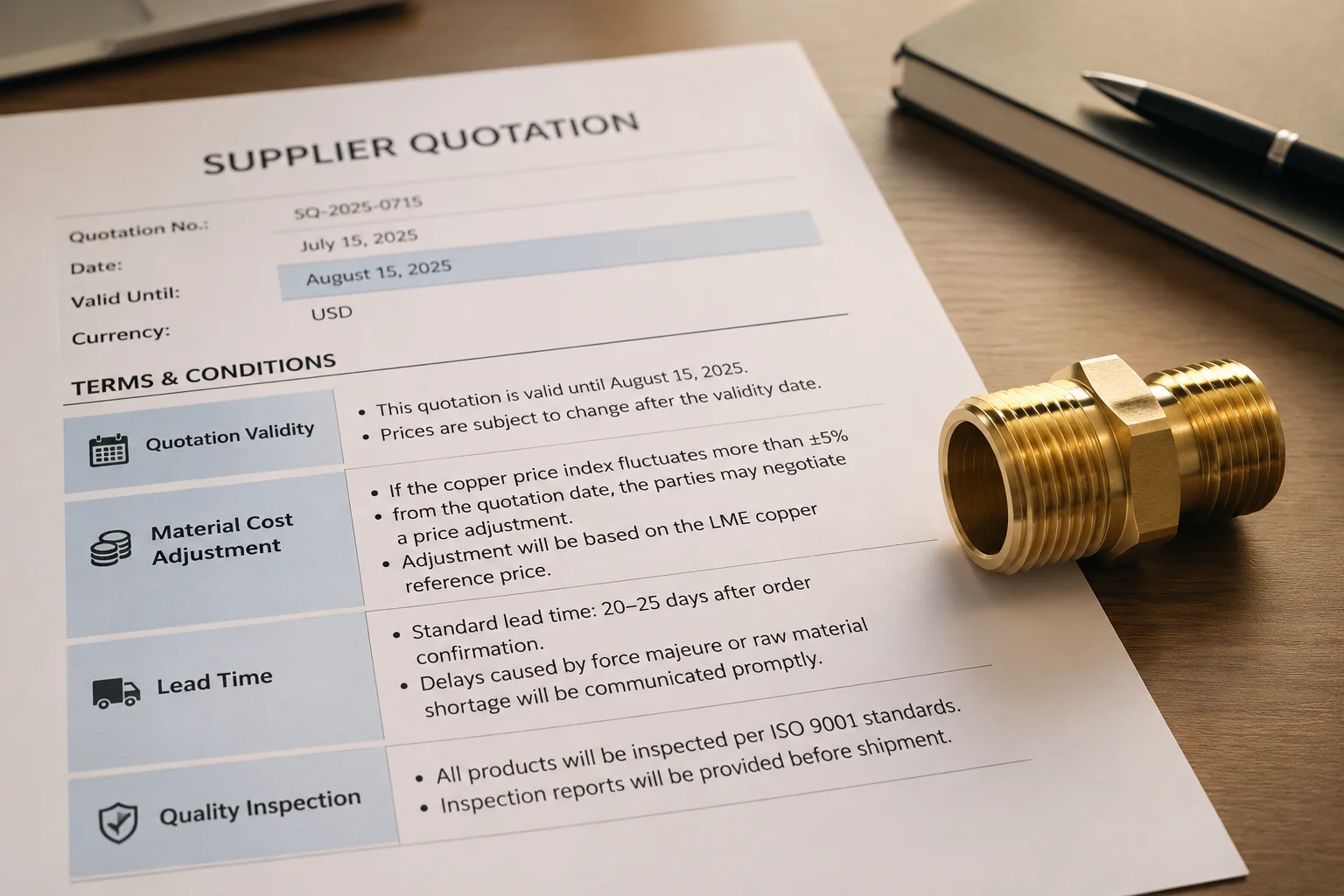
Importers can protect margins under Section 232 copper tariffs by negotiating clear quotation validity, material adjustment rules, production lead times, shipment options, MOQ flexibility, quality inspection standards, and after-sales responsibilities. These terms help buyers manage landed cost instead of reacting to surprises after the purchase order is placed.
Quotation validity should be written clearly
In a stable market, buyers may assume a price remains available for weeks. In a volatile market, that assumption can create conflict. I recommend that every quotation include a clear validity period.
A practical quotation should state:
- Price validity date
- Currency
- Incoterm, such as FOB or DDP if available
- MOQ
- Lead time after deposit or order confirmation
- Packaging requirements
- Material or copper cost adjustment rule, if any
- Inspection standard
- Shipment method
- Payment terms
This does not eliminate price changes. It makes them visible.
Material adjustment rules reduce misunderstanding
Some importers prefer fixed pricing for a period. Some suppliers prefer material-linked pricing. Both approaches can work if the rule is clear.
| Pricing Method | Advantage | Risk | Best Use |
|---|---|---|---|
| Fixed price | Easy for buyer budgeting | Supplier may shorten validity | Short-term orders |
| Material-linked price | Reflects market movement | Buyer needs cost tracking | Long-term programs |
| Tiered volume price | Rewards larger orders | Requires forecast accuracy | Distributor stock orders |
| Mixed-SKU pricing | Supports flexible inventory | More complex quotation | Wholesalers with many SKUs |
A material adjustment rule should not be vague. It should define the reference material, adjustment timing, and whether the change applies before or after order confirmation.
Lead time terms protect stock availability
For 2026 planning, lead time should be treated as a cost factor. A late shipment can force an importer to buy emergency stock, lose sales, or disappoint key customers.
Buyers should clarify:
- Standard production lead time
- Peak season lead time
- Partial shipment options
- Safety stock agreements
- Forecast sharing process
- Urgent order handling
- Port and logistics flexibility
At Yaochong, we operate near Ningbo Port, and I have seen how much export convenience matters when buyers need stable replenishment. Still, location alone is not enough. A supplier also needs production discipline, rolling stock planning, and clear communication.
Quality terms prevent expensive claims
Tariff pressure can push buyers to focus too much on cost. However, a quality failure can erase all savings. I suggest that importers define quality terms before production begins.
Important quality terms include:
- Brass grade requirements, such as H59 or H62 where applicable
- Drawing or sample approval
- Thread gauge inspection
- Air tightness testing
- Pressure resistance testing, such as 500 PSI where required by product type
- Salt spray testing for corrosion resistance
- AQL final inspection standard
- Batch traceability
- Claim response timeline
For DOT-certified products, buyers should also verify applicable DOT and FMVSS 106 requirements. The supplier should provide consistent production control, but the importer should confirm market-entry requirements with qualified professionals.
Flexible delivery terms may reduce operational pressure
Some buyers prefer FOB because they control freight. Others ask about DDP because they want a smoother landed-cost picture. Each method has advantages and risks. The right choice depends on the importer’s internal team, broker relationship, freight volume, and risk tolerance.
The key is not to choose one term blindly. The key is to compare the full cost and responsibility under each option.
Frequently Asked Questions
Are Section 232 copper tariffs guaranteed to apply to all brass fittings in 2026?
No. Importers should not assume that all brass fittings are affected in the same way. Applicability may depend on product scope, HTS classification, origin, and final customs interpretation. Buyers should verify each product category with a licensed customs broker or trade advisor before making pricing decisions.
Should I raise my brass fitting prices now because of tariff uncertainty?
You should first calculate landed cost under several scenarios. A price increase may be necessary for margin protection, but it should be based on cost data, inventory position, competitor conditions, and quotation validity. Many importers use staged price adjustments instead of one sudden increase.
Is copper cost the main reason brass fitting prices change?
Copper cost is important because brass contains copper, but it is not the only factor. Machining complexity, thread tolerance, fitting weight, testing requirements, surface treatment, packaging, MOQ, and supplier capacity also affect pricing. DOT brass fittings may carry additional quality and compliance-related cost.
Can I avoid tariff risk by changing suppliers or countries?
A supplier or country change may reduce one risk, but it can create others.[^11] Importers must verify origin rules, classification, quality systems, lead time, and documentation. A lower unit price is not enough if the product fails inspection, leaks, ships late, or creates customs uncertainty.
What should I ask suppliers before placing 2026 orders?
You should ask about quotation validity, lead time, MOQ, material adjustment rules, inspection standards, testing methods, shipment options, and after-sales responsibility. You should also ask whether the supplier can support scenario planning, mixed-SKU orders, safety stock, and stable repeat production.
Conclusion
Section 232 copper tariffs should push brass fittings importers to think beyond a simple unit price increase. The better strategy is to review total landed cost, product-specific risk, quotation validity, lead time, inventory exposure, and supplier reliability. I recommend building 2026 purchasing plans around clear scenarios instead of one fixed assumption. If you are reviewing brass fittings, DOT fittings, or custom brass components for 2026, contact our team to discuss specifications, lead time, and practical sourcing options.
[^1]: "Section 232 Investigation on the Effect of Imports of Steel on ...", https://www.commerce.gov/issues/trade-enforcement/section-232-steel. A U.S. government notice or proclamation concerning Section 232 action on copper imports provides the policy context for tariff-related planning risk; it does not, by itself, quantify the effect on brass fittings importers. Evidence role: historical_context; source type: government. Supports: An official U.S. government source should document the Section 232 copper policy action or investigation that creates tariff uncertainty for importers.. Scope note: Contextual support only unless the source expressly lists brass fittings or the relevant HTS categories. [^2]: "Determine Total Export Price", https://www.trade.gov/determine-total-export-price. Trade and customs guidance commonly defines landed cost as the full cost of imported goods after purchase price, transportation, insurance, duties, taxes, and import handling charges are included. Evidence role: definition; source type: institution. Supports: A neutral trade or educational source should define landed cost as including purchase price plus duties, freight, insurance, and other import-related expenses.. [^3]: "Determining Duty Rates", https://www.cbp.gov/trade/programs-administration/determining-duty-rates. U.S. customs and tariff authorities explain that imported merchandise is classified under the Harmonized Tariff Schedule, and that classification is used to determine applicable duty treatment. Evidence role: mechanism; source type: government. Supports: A customs or tariff authority should explain that imported goods are classified under the Harmonized Tariff Schedule and that classification affects duty treatment.. [^4]: "Customs Duty Information", https://www.cbp.gov/travel/international-visitors/know-before-you-visit/customs-duty-information. U.S. Customs and Border Protection guidance describes duties, taxes, and fees as being determined through the import entry process, supporting the point that tariff costs may be recognized after the purchase order is placed. Evidence role: mechanism; source type: government. Supports: A customs source should support that duties and fees are handled through the import entry process rather than necessarily at the supplier purchase date.. [^5]: "Brass", https://en.wikipedia.org/wiki/Brass. Reference works define brass as an alloy principally composed of copper and zinc, which provides the materials basis for linking brass fitting costs to copper price movements. Evidence role: definition; source type: encyclopedia. Supports: A materials reference should confirm that brass is a copper-zinc alloy.. Scope note: The source supports the material composition, not the magnitude of any specific price change. [^6]: "H59 vs H62 Brass: A Full Comparison", https://tirapid.com/h59-brass/. Materials standards and engineering references distinguish brass grades by composition and mechanical properties, supporting the need to evaluate H59 and H62 as different material inputs. Evidence role: general_support; source type: institution. Supports: A materials standard or engineering reference should document composition or property differences between H59 and H62 brass.. Scope note: The source may support technical differences between grades without directly documenting supplier-specific cost structures. [^7]: "Screw-thread standards for federal services 1944", https://nvlpubs.nist.gov/nistpubs/Legacy/hb/nbshandbook28-1944.pdf. Thread standards and metrology guidance specify dimensional requirements and gauging practices for pipe threads, supporting the need for accurate gauges and controlled production in threaded fittings. Evidence role: mechanism; source type: institution. Supports: A standards or metrology source should show that thread forms such as NPT are controlled by dimensional standards and checked using gauges.. Scope note: The source may address threaded components generally rather than brass fittings specifically. [^8]: "2023-02-22-NASA-STD-7012A-Approved.pdf", https://standards.nasa.gov/sites/default/files/standards/NASA/A/0/2023-02-22-NASA-STD-7012A-Approved.pdf. Published testing and inspection standards for corrosion exposure, pressure integrity, leakage, and thread gauging treat these checks as controlled quality-assurance procedures requiring appropriate equipment and methods. Evidence role: general_support; source type: institution. Supports: Testing standards should support that corrosion, pressure, leak, and thread inspections are formal quality-control activities requiring specified procedures or equipment.. Scope note: The cited standards may substantiate the testing methods but may not quantify labor cost for a particular factory. [^9]: "49 CFR 571.106 -- Standard No. 106; Brake hoses.", https://www.ecfr.gov/current/title-49/subtitle-B/chapter-V/part-571/subpart-B/section-571.106. Federal Motor Vehicle Safety Standard No. 106 sets requirements for brake hoses, assemblies, and related end fittings, supporting the article’s distinction between brake-related fittings and ordinary commodity hardware. Evidence role: general_support; source type: government. Supports: A U.S. transportation safety source should show that brake hoses and related end fittings are subject to federal safety requirements.. Scope note: The regulation may apply directly only to covered brake hose assemblies and components, so applicability to a specific brass fitting must be verified by product use and classification. [^10]: "Dataset | Logistics Performance Indicators (LPI) 2.0", https://data360.worldbank.org/en/dataset/WB_LPI_20. International logistics research identifies port congestion, customs procedures, and inland transport performance as factors that can affect shipment timing and supply-chain reliability. Evidence role: general_support; source type: institution. Supports: An international institution or government logistics source should support that port, customs, and inland freight conditions can affect shipment lead times.. Scope note: The source would support the general logistics mechanism, not a specific delay for brass fittings in 2026. [^11]: "Supply chain risk management: A content analysis-based ...", https://www.sciencedirect.com/science/article/pii/S2949863523000304. Supply-chain risk management literature treats supplier changes as risk-reallocation decisions that may reduce one exposure while increasing risks related to quality, delivery reliability, coordination, or compliance. Evidence role: expert_consensus; source type: paper. Supports: Supply-chain risk literature should support that changing suppliers can shift risk across cost, quality, delivery, and compliance dimensions.. Scope note: The source would support the general sourcing-risk principle rather than the outcome of any specific supplier change.