Brass Fittings in Truck Air Brake Systems: Complete Application Guide?
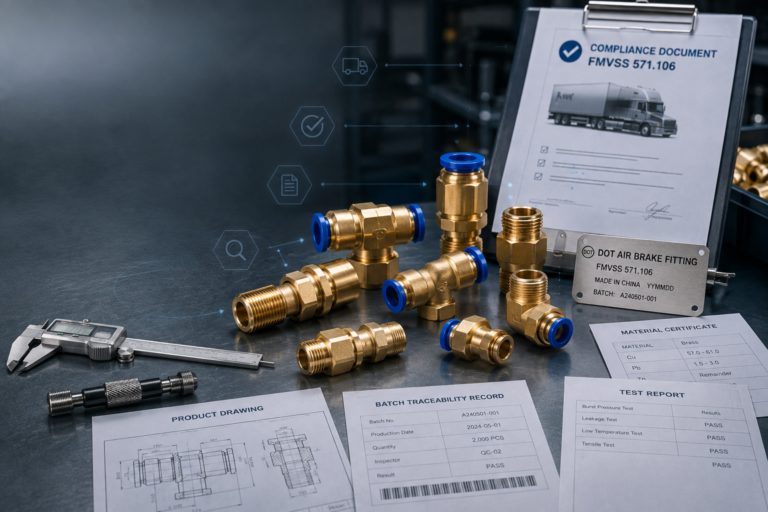
Brass fittings in truck air brake systems can look simple on a purchase list, but the wrong selection can create compliance doubts, leakage complaints, dead stock, and costly returns[^1]. Many buyers focus only on size. I recommend a safer path: confirm standards, connection type, sealing performance, application position, and supplier capability before ordering.
Brass fittings in truck air brake systems should be selected by checking market compliance, DOT/FMVSS 106[^2] relevance, tube size, thread specification, fitting type, sealing test results, and supplier consistency. Buyers should not treat ordinary pneumatic fittings as automatic substitutes for air brake fittings[^3], because application requirements and verification documents may differ.
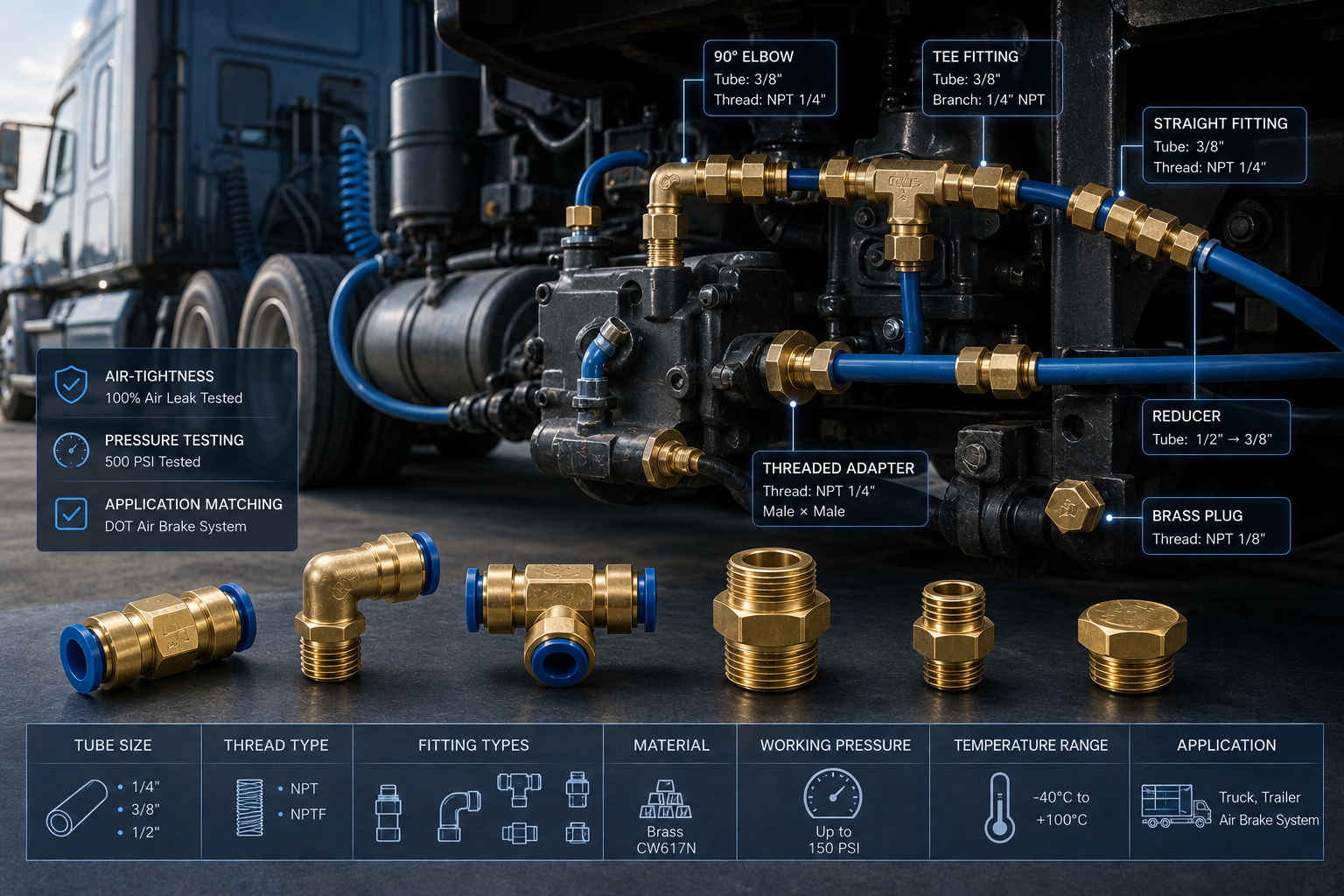
When I speak with importers and truck parts distributors, the most common problem is not a lack of product options. The real problem is incomplete confirmation. A fitting may match a tube size but fail to match the buyer’s target market, thread standard, quality documentation, or long-term inventory plan.
How Should Buyers Evaluate Brass Fittings in Truck Air Brake Systems?
Buying brass fittings in truck air brake systems by size alone creates hidden risk. A part that looks correct in a catalog may not match the required standard, tube, thread, or end-use position. This can lead to returns and confused after-sales discussions.
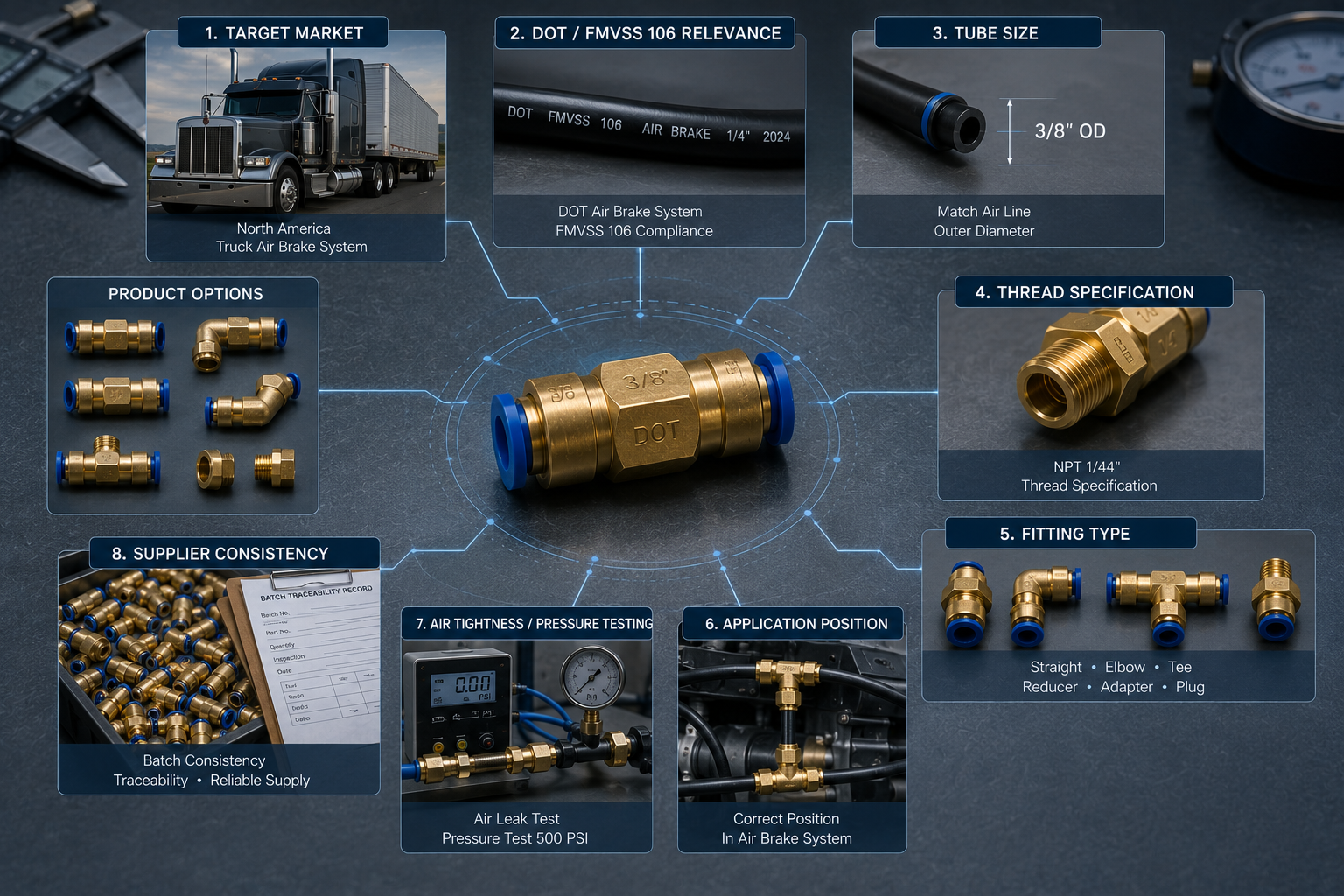
The correct evaluation sequence is: target market requirements first, DOT/FMVSS 106 relevance second, then tube size, thread type, fitting structure, application position, quality testing, and supplier delivery stability. This order helps buyers reduce mismatch risk before samples, bulk orders, or distributor inventory planning.
Start With the Target Market
I usually begin a new inquiry with one question: “Which market will these fittings be sold into?” This question sounds basic, but it changes the whole purchasing conversation.
For example, a distributor selling into North America may need DOT-related air brake fittings and documentation connected with FMVSS 106 requirements.[^4] A buyer serving general industrial pneumatic users may have different needs. These two categories should not be mixed casually.
Buyers should confirm:
- Destination market: United States, Canada, Latin America, Europe, Middle East, or mixed markets
- Application category: truck air brake system, trailer connection, pneumatic equipment, or general fluid connection
- Required documentation: ISO 9001 certificate, DOT-related product compliance documents, material certificate, test report, or batch inspection record
- Sales channel: wholesale, repair parts distribution, OEM-style supply, or private label packaging
I am a brass fittings supplier, not a vehicle brake system engineer. I help buyers clarify fitting specifications and supplier-side quality controls. Final application decisions should be verified by qualified technical teams.
Separate Compliance, Thread, Tube, and Fitting Type
A frequent misunderstanding is that buyers treat terms like DOT, NPT, tube size, and fitting type as if they mean the same thing. They do not.
| Term | What It Usually Means | Why Buyers Should Care |
|---|---|---|
| DOT / FMVSS 106 relevance | Market or safety standard requirement for air brake hose/tubing assemblies and related components | It affects compliance documents and product qualification |
| [NPT thread | A tapered pipe thread standard](https://en.wikipedia.org/wiki/National_pipe_thread)[^5] | It affects threaded sealing and matching with ports |
| Tube size | The outside diameter of the tube, often in inch sizes | It affects tube connection fit |
| Fitting type | Coupling, elbow, tee, reducer, plug, push-to-connect, compression, etc. | It affects the application position and inventory category |
| Material | Brass grade and surface treatment | It affects corrosion resistance, machinability, and cost |
A fitting can have an NPT thread but still not be suitable for a truck air brake purchasing program. A fitting can also match a tube diameter but fail to match the required fitting structure. This is why I always ask for drawings, samples, photos, or part numbers when possible.
Use a Practical Confirmation Checklist
Before a buyer places even a trial order, I suggest confirming these points:
- Does the target market require DOT/FMVSS 106-related products?
- What tube outside diameter must the fitting match?
- What thread standard and thread size are required?
- Is the fitting straight, elbow, tee, reducer, plug, or custom type?
- Is it push-to-connect, threaded, compression, or another connection style?
- What tests should be verified before shipment?
- Does the supplier support samples, mixed SKUs, and future bulk supply?
At Yaochong, we usually support this process through specification review, sample confirmation, and batch inspection discussion. Our production context includes CNC machining, thread forming, air tightness testing, 500 PSI pressure resistance testing, thread gauge inspection, and AQL final sampling[^6]. Buyers should still verify certificates, inspection reports, and samples against their own market and technical requirements.
Where Are Brass Fittings in Truck Air Brake Systems Commonly Applied?
Brass fittings in truck air brake systems are commonly purchased as connection components for air tubing, threaded ports, directional changes, branch connections, reductions, plugs, and service inventory. Buyers should treat these as procurement categories, not installation instructions, because final placement depends on the vehicle and technical requirements.
A buyer-friendly application view includes straight couplings, elbows, tees, reducers, plugs, threaded adapters, and push-to-connect fitting categories. Each category solves a connection problem, but the correct part must still match the tube, thread, pressure expectation, sealing method, and applicable compliance requirement.

Common Procurement Categories
Most distributor inquiries I receive fall into several product families. Buyers often ask for a “DOT fitting assortment,” but the real order usually contains many small SKUs. Each SKU needs its own confirmation.
| Category | Typical Buyer Use | Main Confirmation Points |
|---|---|---|
| Straight couplings | Connecting compatible tubing or line sections | Tube OD, fitting style, air tightness |
| Elbows | Changing connection direction | Angle, tube size, thread size, clearance |
| Tees | Creating branch connections | All end sizes, fitting layout, market requirement |
| Reducers | Connecting different sizes | Large/small end specs, sealing design |
| Plugs | Closing ports or unused openings | Thread type, material, sealing requirement |
| Threaded adapters | Matching ports and tubing systems | NPT or other thread, male/female type |
| Custom brass fittings | Special customer drawing or sample | Drawing tolerance, sample approval, MOQ |
This structure helps buyers build a cleaner inventory list. It also reduces the chance that a warehouse team orders a visually similar but technically different item.
Do Not Treat This as a Repair Manual
This article is not an installation guide. Truck air brake systems are safety-related systems[^7], and installation or replacement decisions should stay with qualified maintenance teams, vehicle manufacturers, or technical specialists.
However, procurement teams still need to understand application categories. If the buyer cannot separate a tee from a reducer, or a push-to-connect style from a threaded adapter, the sourcing conversation becomes slow and risky.
In practice, I often see inquiries like:
- “We need DOT brass fittings for trucks. Please quote all sizes.”
- “Can your NPT fittings be used for air brake?”
- “We need 1/4, 3/8, and 1/2 fittings. Are they DOT?”
- “Please make this sample, but we do not have the drawing.”
These inquiries are normal, but they need clarification. A good supplier should not simply quote the lowest price without asking follow-up questions.
Match Application Category With Purchasing Risk
Each fitting category creates a different buying risk.
- Straight fittings may seem simple, but tube size mismatch can create returns.
- Elbows require attention to angle, clearance, and thread direction.
- Tees can cause confusion when the three ends are not the same size.
- Reducers require clear identification of the larger and smaller ends.
- Plugs require accurate thread matching and sealing expectations.
- Custom fittings require drawings, tolerances, samples, and approval steps.
For distributors, these details affect stock accuracy. A wrong SKU can sit in the warehouse for months. Worse, it can be sold to a customer and then come back as a complaint. That is why I prefer a structured SKU sheet with photos, dimensions, thread callouts, tube sizes, material notes, and packaging requirements.
At Yaochong, we manufacture standard DOT fittings, NPT threaded fittings, straight couplings, elbows, tees, reducers, plugs, and custom brass fittings. Because we work with wholesalers and importers, I see how important SKU clarity is. A clean purchase specification saves time for both sides.
Why Is DOT/FMVSS 106 Verification Important for Brass Fittings in Truck Air Brake Systems?
DOT/FMVSS 106 verification matters because not every brass fitting is suitable for truck air brake purchasing programs. Buyers need to confirm whether their market requires DOT-related air brake fittings, what documents should be reviewed, and whether the supplier can support consistent production and traceable inspection.
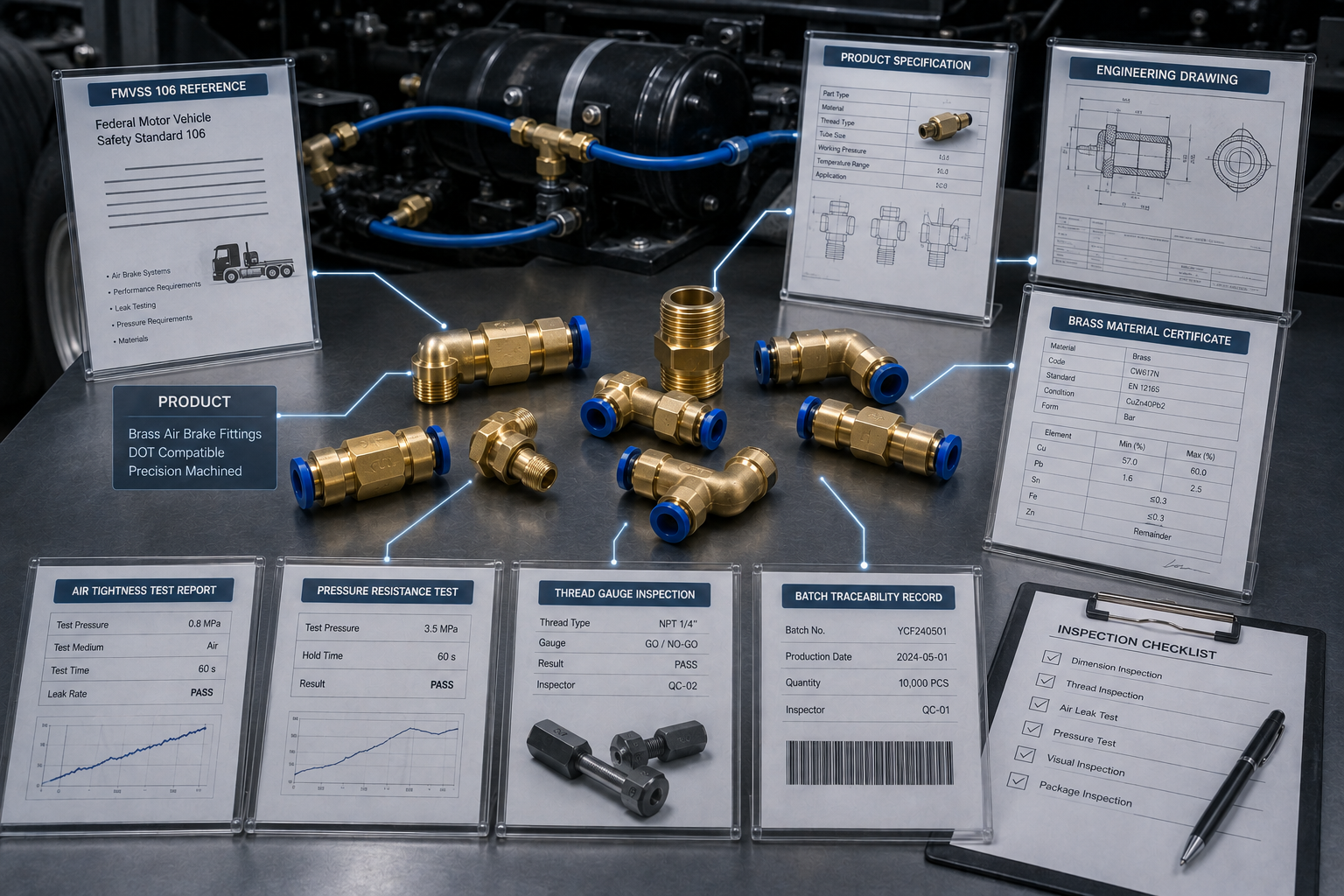
A practical buyer should verify product compliance documents, sample performance, thread accuracy, air tightness, pressure resistance, material records, and batch traceability. Certification claims should be treated as documents to review, not as marketing words to accept without checking.
What DOT and FMVSS 106 Mean in Purchasing Discussions
In truck parts sourcing, buyers often use “DOT fitting” as a shorthand. Still, the purchasing team should be more precise. DOT-related air brake fittings are connected to market access expectations and standards such as FMVSS 106 for brake hoses and related brake system components in the U.S. context.
This does not mean a buyer should accept any item labeled “DOT.” It means the buyer should ask for proof, review the product category, and confirm that the fitting matches the intended sales market.
A good supplier conversation may include:
- “Do these fittings support DOT-related air brake applications?”
- “What documentation can you provide for buyer review?”
- “Can you provide samples before bulk order?”
- “How do you inspect thread precision?”
- “What pressure or air tightness testing is performed?”
- “Can you keep batch records for traceability?”
Why Ordinary Pneumatic Fittings Are Not Automatically Suitable
Another common misunderstanding is that air is air. Some buyers assume ordinary pneumatic fittings can be used wherever compressed air is present. This assumption creates risk.
Truck air brake purchasing has its own compliance and reliability expectations. General pneumatic fittings may be designed for industrial equipment, workshop air lines, automation systems, or other non-vehicle uses.[^8] These products may not carry the same documentation, thread requirements, or market acceptance.
The buyer should not ask only, “Can air pass through it?”
The buyer should ask, “Is this fitting suitable for my truck air brake sales market, customer requirement, and compliance file?”
Supplier-Side Quality Controls Buyers Should Ask About
From a manufacturing perspective, brass fittings look small, but quality depends on many controlled steps. Buyers should ask how the supplier manages the process from brass bar to finished fitting.
At Yaochong, our standard quality-control discussion usually covers:
| Quality Point | Buyer Concern | Verification Method |
|---|---|---|
| Raw material | Brass grade consistency | H59/H62 brass bar inspection, supplier certificate review |
| Thread precision | Port matching and sealing | Thread gauge inspection |
| Air tightness | Leakage complaints | Air tightness testing |
| Pressure resistance | Performance confidence | 500 PSI pressure resistance testing in our QC context |
| Surface condition | Corrosion resistance and appearance | Salt spray testing and visual inspection[^9] |
| Batch consistency | Repeat order stability | In-process records and final AQL sampling |
| Traceability | Complaint handling and improvement | Batch records from material to finished product |
Buyers should request these controls in writing when the application is sensitive. A professional supplier should be able to explain what is checked, how often it is checked, and what records can be shared.
I also suggest that buyers keep approved samples. A physical approved sample helps reduce disputes later. If a repeat batch differs in thread, length, surface, marking, or packaging, both sides can compare it with the approved sample and inspection standard.
How Do Tube Size, Thread Type, and Fitting Structure Affect Purchasing?
Tube size, thread type, and fitting structure affect whether a brass fitting will physically match the buyer’s product system and inventory list. These terms are related, but they are not interchangeable. A correct purchase order should identify all three clearly.
Buyers should specify tube outside diameter, thread standard, thread size, male/female type, fitting shape, connection style, material, surface requirement, and packaging. If any item is unclear, the supplier should confirm before production instead of guessing.
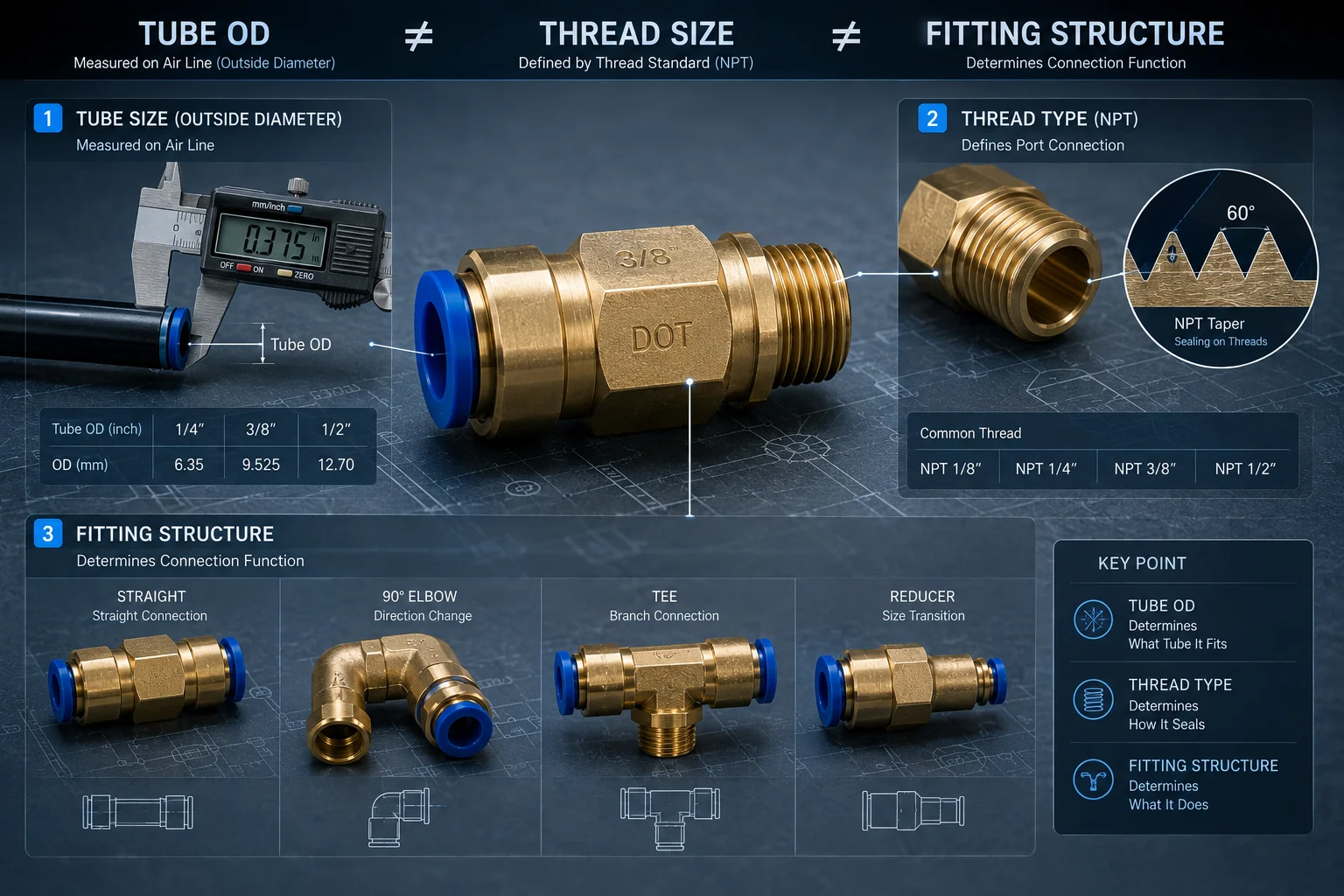
Tube Size Is Not Thread Size
Tube size usually refers to the outside diameter of the tube.[^10] Thread size refers to the threaded connection. These numbers can appear similar, which causes confusion.
For example, a buyer may say “1/4 fitting,” but that phrase may refer to:
- 1/4 inch tube OD
- 1/4 NPT thread
- A fitting with one 1/4 end and one different end
- A local shorthand used by a customer or warehouse
This is why I ask for photos, drawings, or samples. A clear drawing removes most uncertainty. If a drawing is not available, buyers should provide at least the following:
- Product photo from multiple angles
- Tube OD requirement
- Thread standard and size
- Male or female thread
- Overall length or key dimensions
- Fitting type, such as elbow, tee, coupling, or reducer
- Required standard or market, such as DOT-related application
NPT Is a Thread Standard, Not a Complete Product Definition
NPT is common in North American fluid connection products. It is a tapered pipe thread.[^11] However, “NPT fitting” does not automatically define the full product.
A buyer still needs to confirm:
- Is it male NPT or female NPT?
- What is the thread size?
- What is the other end connection?
- Is the fitting straight, elbow, tee, or reducer?
- Does the product need DOT-related documentation?
- What sealing method is expected?
This distinction matters for stock planning. If a distributor imports a container of “NPT brass fittings” without separating air brake SKUs from general industrial SKUs, the warehouse may face labeling problems and sales confusion.
Fitting Structure Affects MOQ and Production Planning
Different structures also affect production cost and lead time. A simple straight coupling may be easier to mass-produce than a special tee with different ends. Custom brass fittings may require drawing review, tooling or fixture consideration, sample approval, and longer production planning.
Here is a practical sourcing comparison:
| Order Type | Best For | Buyer Advantage | Buyer Risk |
|---|---|---|---|
| Standard SKU order | Common distributor stock | Faster quotation and delivery | Must verify exact specification |
| Mixed small order | Testing market demand | Lower inventory pressure | Higher per-unit handling complexity |
| Sample order | Specification confirmation | Reduces bulk order mistakes | Takes extra approval time |
| OEM/ODM order | Private label or special design | Better product fit | Needs drawings, samples, and QC agreement |
| Full-container order | Mature high-volume demand | Better unit cost and stable supply | Higher inventory exposure if specs are wrong |
At Yaochong, we support flexible MOQs for small-batch mixed orders and larger bulk orders. This is useful for distributors who want to test a DOT brass fitting range before committing to full-container purchasing. However, I still recommend sample confirmation for new SKUs. A small delay before mass production is usually cheaper than a large return after delivery.
How Can Buyers Reduce Leakage, Return, and Dead Inventory Risk?
Buyers can reduce leakage, return, and dead inventory risk by combining technical confirmation with supplier evaluation. The buyer should verify sealing performance, thread accuracy, material consistency, sample approval, production capacity, lead time, and after-sales response before relying on a supplier for repeat orders.
The safest purchasing process is sample confirmation, documented specification approval, controlled batch production, inspection before shipment, and repeat-order traceability. This process helps distributors protect customer trust and avoid unstable inventory results.
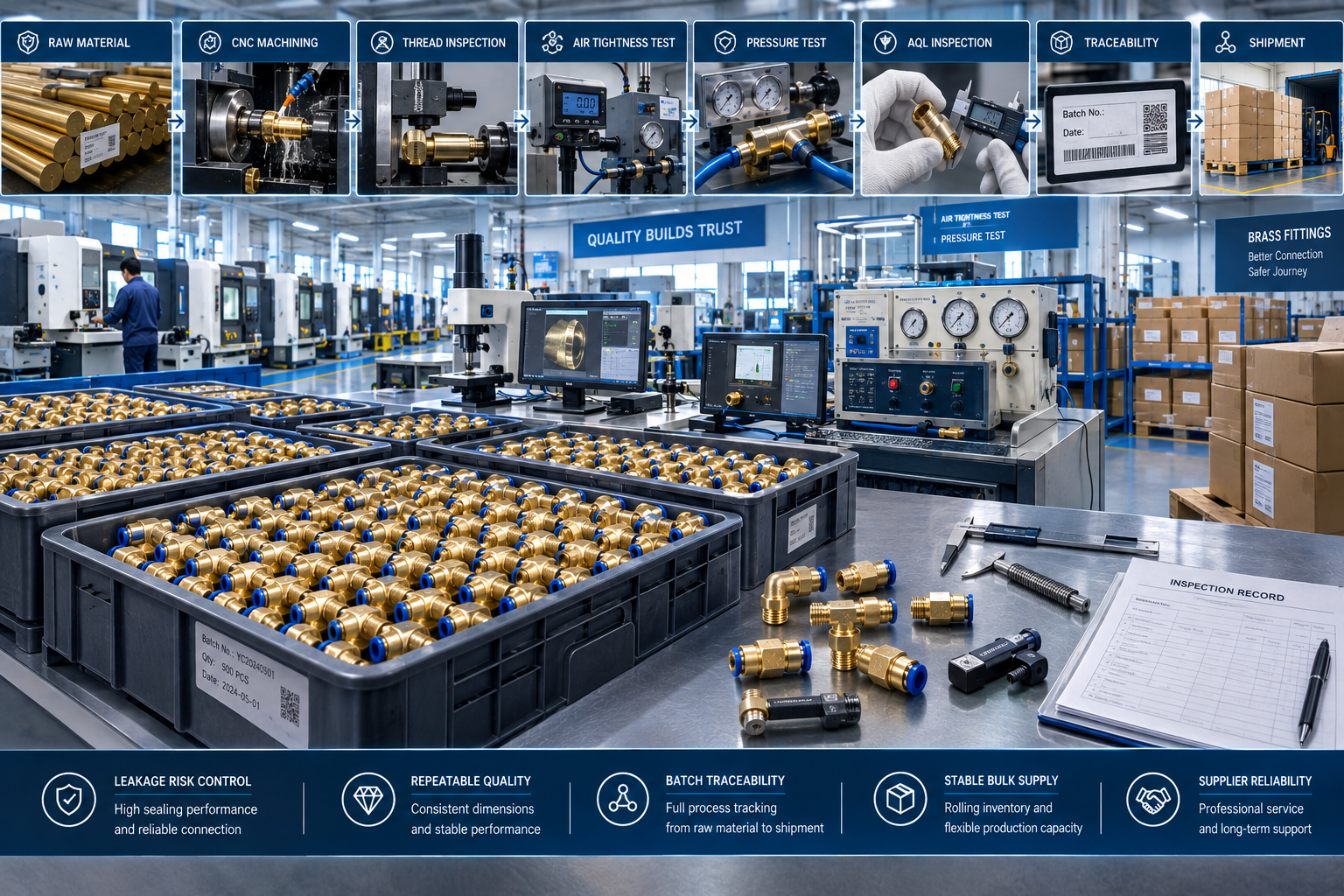
Technical Quality Becomes Commercial Risk
Procurement teams often see quality as a technical issue, but it quickly becomes a commercial issue. A fitting with poor thread precision may become a customer complaint. Unstable sealing may become a return. Inconsistent dimensions may become dead stock. Unclear compliance may block sales into certain markets.
Common risk points include:
- Leakage complaints caused by poor sealing performance or mismatched parts
- Customer returns caused by incorrect tube or thread specification
- Dead inventory caused by wrong SKU labeling or unclear market requirement
- Delayed sales plans caused by supplier lead-time instability
- Price disputes caused by unclear material, packaging, or inspection standards
- Brand damage caused by inconsistent repeat batches
A low unit price does not always mean a lower total cost. If a distributor saves a few cents per fitting but receives unstable batches, the real cost may appear later in warehouse handling, claims, replacement shipments, and customer dissatisfaction.
What I Suggest Buyers Ask Suppliers
Before choosing a long-term brass fittings supplier, buyers should ask direct questions. A strong supplier should answer clearly.
Compliance and documentation
- Can you provide DOT-related product documents for review where applicable?
- Do you have ISO 9001 quality management certification?
- Can you provide material certificates or batch records?
Manufacturing and inspection
- Do you manufacture in-house or outsource key processes?
- How do you inspect threads?
- Do you perform air tightness testing?
- What pressure resistance testing do you perform?
- Do you use AQL sampling before warehousing or shipment?
Supply and order support
- Can you support mixed small orders?
- Can you maintain stock for standard items?
- What is your normal lead time?
- Can you support OEM/ODM packaging?
- Can you provide FOB, DDP, or other flexible delivery options?
Evaluate the Supplier, Not Only the Product
For truck parts importers, supplier stability matters as much as product selection. A supplier with weak communication can create delays even if the product is acceptable. A supplier with poor traceability may struggle to investigate complaints. A supplier without stable brass sourcing may change costs frequently.
In our own factory context, Yaochong operates a 3,000㎡ brass fitting production base in Ningbo, about 30 km from Ningbo Port. We use precision CNC lathes, thread rolling machines, automatic tapping machines, ultrasonic cleaning lines, and surface treatment lines. Our annual output exceeds 5 million brass fittings. I share these details because buyers often ask whether we can support both small mixed orders and larger repeat orders.
Still, buyers should not rely only on factory claims. They should verify documents, request samples, inspect shipment quality, and build a supplier scorecard. A simple scorecard may include:
| Supplier Evaluation Item | Suggested Weight |
|---|---|
| Specification confirmation ability | 20% |
| Compliance documentation support | 20% |
| Quality-control system | 20% |
| Price competitiveness | 15% |
| Lead-time stability | 15% |
| Communication and after-sales support | 10% |
This method keeps purchasing decisions balanced. It prevents the buyer from choosing only the cheapest quote and later paying for hidden operational problems.
Frequently Asked Questions
Are all brass fittings suitable for truck air brake systems?
No. Not every brass fitting is suitable for truck air brake systems. Buyers should confirm DOT/FMVSS 106 relevance, tube size, thread standard, fitting type, sealing performance, and supplier documentation. Ordinary pneumatic fittings should not be treated as automatic substitutes for air brake-related purchasing.
Is NPT the same as DOT?
No. NPT is a tapered pipe thread standard. DOT usually refers to a compliance or market requirement connected with air brake applications. A fitting may have NPT threads, but buyers still need to confirm whether it is suitable for their DOT-related truck air brake program.
What information should I send before requesting a quotation?
You should send the target market, required standard, tube OD, thread type, thread size, male/female type, fitting shape, photos or drawings, order quantity, packaging requirement, and whether samples are needed. This information helps the supplier quote accurately and avoid specification mistakes.
Should I order samples before bulk purchasing?
Yes, samples are strongly recommended for new SKUs or new suppliers. Sample confirmation helps buyers check dimensions, thread fit, sealing expectations, surface quality, packaging, and documentation before bulk production. It also creates an approved reference for future repeat orders.
What quality tests should buyers ask about?
Buyers should ask about raw material inspection, thread gauge inspection, air tightness testing, pressure resistance testing, salt spray testing, final AQL sampling, and batch traceability. The exact test requirements should match the buyer’s market, application, and internal quality standards.
Conclusion
Brass fittings in truck air brake systems should be purchased through a structured confirmation process, not by size alone. Buyers need to check target market requirements, DOT/FMVSS 106 relevance, tube and thread specifications, fitting type, sealing performance, inspection records, and supplier stability. If you are sourcing DOT brass fittings, NPT fittings, elbows, tees, reducers, plugs, or custom brass fittings, I can help review your specifications, prepare samples, and support stable OEM/ODM supply for distributor and importer programs.
[^1]: "Interpretation ID: nht93-3.42", https://www.nhtsa.gov/interpretations/nht93-342. Institutional quality and vehicle-safety sources describe how defective or nonconforming components can generate field failures, corrective actions, recalls, and cost-of-poor-quality consequences, supporting the article’s general link between wrong fitting selection and downstream commercial risk. Evidence role: general_support; source type: institution. Supports: Component defects or specification mismatches in vehicle safety systems can result in compliance actions, leaks, recalls, returns, and added quality costs.. Scope note: The source may support the general risk pattern rather than quantify costs specifically for brass truck air-brake fittings. [^2]: "49 CFR 571.106 -- Standard No. 106; Brake hoses.", https://www.ecfr.gov/current/title-49/subtitle-B/chapter-V/part-571/subpart-B/section-571.106. 49 C.F.R. § 571.106 identifies FMVSS No. 106 as the federal standard for brake hoses, brake hose assemblies, and brake hose end fittings, providing the regulatory basis for discussing DOT/FMVSS 106 relevance in U.S. brake-related purchasing. Evidence role: definition; source type: government. Supports: FMVSS No. 106 is a U.S. federal motor vehicle safety standard governing brake hoses, brake hose assemblies, and brake hose end fittings.. [^3]: "49 CFR 571.106 -- Standard No. 106; Brake hoses.", https://www.ecfr.gov/current/title-49/subtitle-B/chapter-V/part-571/subpart-B/section-571.106. Federal brake-hose regulations specify performance requirements for brake hoses, assemblies, and end fittings, supporting the article’s caution that a fitting intended for general pneumatic service is not automatically suitable for an air-brake application. Evidence role: general_support; source type: government. Supports: Brake hose and end-fitting components are governed by specific safety-performance requirements, so generic pneumatic compatibility alone is not sufficient to establish suitability.. Scope note: The regulation supports the need for application-specific verification; it does not evaluate every type of ordinary pneumatic fitting. [^4]: "Interpretation ID: 04-009159drn", https://www.nhtsa.gov/interpretations/04-009159drn. NHTSA’s FMVSS No. 106 framework establishes U.S. requirements for covered brake hoses, brake hose assemblies, and brake hose end fittings, giving regulatory context to requests for DOT-related documentation in North American purchasing. Evidence role: historical_context; source type: government. Supports: U.S. brake hose and end-fitting products are regulated under FMVSS No. 106, and manufacturers certify compliance for covered products.. Scope note: The source establishes U.S. federal context; Canadian or Mexican requirements may differ and require separate verification. [^5]: "National pipe thread - Wikipedia", https://en.wikipedia.org/wiki/National_pipe_thread. Standards references for National Pipe Taper threads describe NPT as a tapered pipe-thread form, supporting the article’s definition of NPT as a thread standard rather than a complete fitting specification. Evidence role: definition; source type: institution. Supports: NPT refers to National Pipe Taper thread, a tapered pipe-thread form used for pipe connections.. Scope note: Full dimensional requirements are contained in proprietary standards such as ASME B1.20.1, which may not be freely reproduced in secondary summaries. [^6]: "ISO 2859-1:1999(en), Sampling procedures for inspection by attributes", https://www.iso.org/obp/ui/#iso:std:iso:2859:-1:ed-2:v1:en. ISO 2859-1 and ANSI/ASQ Z1.4 describe acceptance-sampling procedures using acceptance quality limits, supporting the article’s reference to AQL final sampling as a recognized lot-inspection method. Evidence role: definition; source type: institution. Supports: AQL-based acceptance sampling is a standardized inspection approach used to evaluate lots by sampling rather than checking every unit.. Scope note: AQL sampling controls lot acceptance risk statistically; it does not guarantee that every individual fitting in an accepted lot is defect-free. [^7]: "5.1.1 Brake Systems (Part 393 Subpart C) - CSA", https://csa.fmcsa.dot.gov/safetyplanner/MyFiles/SubSections.aspx?ch. Federal motor carrier and vehicle-safety materials treat air brake systems as regulated safety-critical equipment on commercial vehicles, supporting the article’s statement that installation and replacement decisions should be handled by qualified personnel. Evidence role: general_support; source type: government. Supports: Air brake systems on commercial vehicles are subject to safety regulation and inspection because they are critical to vehicle braking performance.. [^8]: "Air-line fitting", https://en.wikipedia.org/wiki/Air-line_fitting. Technical education sources on pneumatic systems describe compressed-air fittings as common components in industrial automation and general compressed-air equipment, supporting the article’s distinction between general pneumatic service and vehicle air-brake applications. Evidence role: general_support; source type: education. Supports: Pneumatic components and fittings are commonly used in industrial automation, compressed-air systems, and workshop equipment.. Scope note: Such sources usually describe typical pneumatic uses and may not address truck air-brake suitability directly. [^9]: "Salt spray test - Wikipedia", https://en.wikipedia.org/wiki/Salt_spray_test. ASTM B117 and ISO 9227 define salt-spray exposure methods for corrosion testing in controlled artificial atmospheres, supporting the article’s inclusion of salt spray testing among surface-condition verification methods. Evidence role: definition; source type: institution. Supports: Salt spray testing is a standardized corrosion test method used to expose materials or coatings to a controlled saline environment.. Scope note: Salt spray results provide comparative corrosion-exposure data and do not necessarily predict exact service life in a real truck environment. [^10]: "Nominal Pipe Size", https://en.wikipedia.org/wiki/Nominal_Pipe_Size. Engineering references distinguish tubing, commonly specified by outside diameter, from pipe, which is often identified by nominal pipe size, supporting the article’s explanation that tube size and thread size should not be conflated. Evidence role: definition; source type: institution. Supports: Tubing is commonly specified by outside diameter, unlike pipe, which is often designated by nominal pipe size.. Scope note: The convention is broadly used but should still be checked against the specific tubing standard or manufacturer specification. [^11]: "National pipe thread - Wikipedia", https://en.wikipedia.org/wiki/National_pipe_thread. Standards and engineering references identify National Pipe Thread as a pipe-thread system used in North America and describe NPT as its tapered form, supporting the article’s statement about NPT’s regional use and geometry. Evidence role: definition; source type: institution. Supports: National Pipe Thread is a North American pipe-thread standard, and NPT denotes the tapered form.. Scope note: The source supports common technical usage; it does not determine whether a specific NPT fitting is appropriate for any particular brake application.