DOT Certification for Air Brake Fittings: What Does FMVSS 571.106 Mean for Buyers?
DOT Certification for Air Brake Fittings can look like a simple checkbox on a supplier quote. However, vague “DOT approved” claims can create real procurement risk[^1] when the fitting is used in a brake system. I usually tell buyers to evaluate the product, documents, markings, tests, and factory controls together.
DOT Certification for Air Brake Fittings generally means the fitting is intended to meet applicable U.S. DOT/FM VSS 571.106 air brake hose and connection requirements, but buyers should verify the exact application, marking, test evidence, material control, and supplier quality system before purchase. It is not just a one-word marketing claim.
In my factory work with brass DOT air brake fittings, I have seen the same question come up many times: “Can you send the DOT certificate?” That question is useful, but it is not enough. A safer purchasing process checks whether the fitting matches the system, standard, batch, and market requirement.
What Does DOT Certification for Air Brake Fittings Really Mean?
Many buyers see “DOT” and assume the product is automatically suitable for every brake application. That assumption can cause confusion. I prefer to treat DOT Certification for Air Brake Fittings as a verification process that connects standard requirements, product design, testing records, and production consistency.
DOT Certification for Air Brake Fittings should be understood as evidence that a fitting is designed and controlled for DOT air brake use, subject to applicable FMVSS 571.106 requirements and buyer verification. It should not replace application review, official regulatory checking, or inspection of actual production batches.
Why “DOT approved” is not enough
In daily export communication, I often hear buyers ask for “DOT approved brass fittings.” I understand the request because wholesalers and distributors need a simple answer for their customers. Still, I avoid treating the phrase as a complete technical conclusion.
A better question is:
“Which exact fitting, for which brake system application, under which standard, with which marking, supported by which test and batch records?”
That question gives procurement teams a stronger basis for supplier evaluation.
For air brake fittings, “DOT” is closely connected to U.S. Department of Transportation requirements and FMVSS 571.106, also referred to as FMVSS 106[^2] in many buyer conversations. The detailed legal meaning should always be checked against official DOT/NHTSA texts and local customer requirements. As a manufacturer, I can support product documentation and factory quality evidence, but I am not a government agency, certification authority, legal adviser, or test laboratory.
What buyers should verify
When I help customers review DOT brass air brake fittings, I usually separate verification into five areas:
| Verification item | Why it matters for procurement |
|---|---|
| Product application | Not every brass fitting is suitable for air brake systems.[^3] |
| Applicable standard | Buyers need to know whether FMVSS 571.106 / FMVSS 106 is relevant to the use case. |
| Product marking | Marking helps identify product type, intended use, and traceability. |
| Testing evidence | Pressure, air tightness, and thread checks support performance claims. |
| Batch quality control | A good sample does not prove stable bulk order quality. |
Common misunderstanding I see
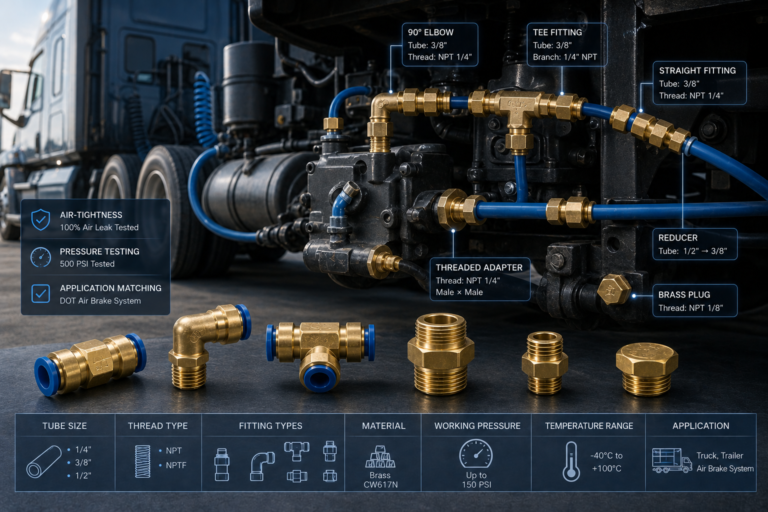
One recurring misunderstanding is the belief that a single certificate can cover every brass fitting in a catalog. In practice, buyers should check the exact part number, drawing, thread type, tube size, sealing method, and target market. A reducer, tee, elbow, plug, or straight coupling may look similar across catalogs, but its intended system use can differ.
For North American distributors, this distinction matters because their customers may install these parts in truck, trailer, or fleet maintenance environments. A mismatch can create return claims, safety concerns, and documentation problems.
How Does FMVSS 571.106 Apply to DOT Certification for Air Brake Fittings?
FMVSS 571.106 can feel like a regulation wall if a buyer only reads standard language. The practical problem is simpler: procurement teams must know whether a fitting is intended for air brake use and whether the supplier can support that claim with documents and repeatable controls.
FMVSS 571.106 provides federal requirements related to brake hoses, brake hose assemblies, and related end fittings.[^4] For DOT Certification for Air Brake Fittings, buyers should use it as a reference point for confirming application, performance expectations, markings, and supplier documentation, while checking official regulatory text for final interpretation.
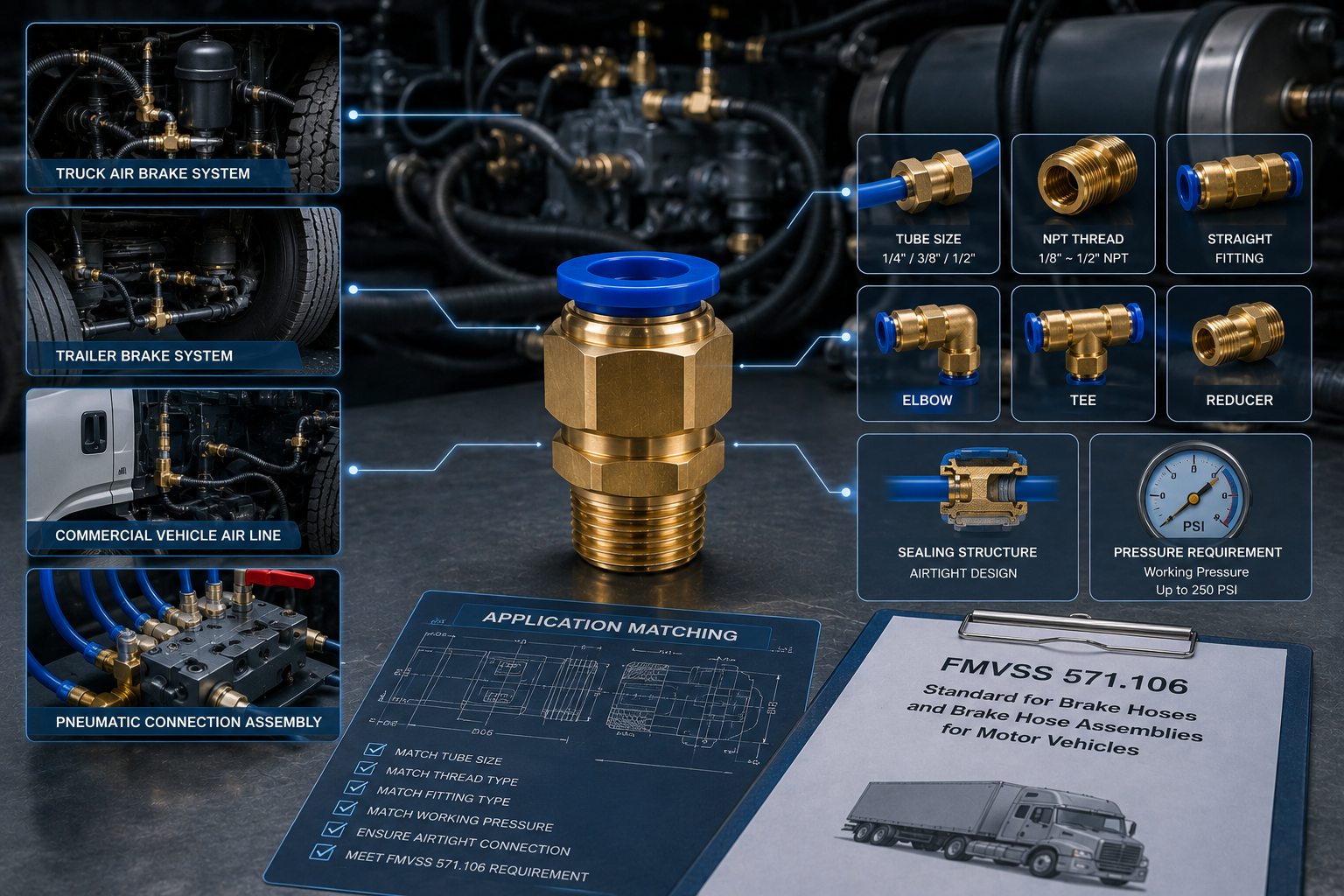
FMVSS 571.106 versus FMVSS 106
In buyer conversations, I see both terms used:
- FMVSS 571.106 is the formal reference within the Code of Federal Regulations.
- FMVSS 106 is the common short form many people use.
- DOT air brake fitting is the purchasing term often used in catalogs and RFQs.
The important point is not the label alone. The important point is whether the fitting is designed, tested, marked, and controlled for the intended brake hose or air brake connection application[^5].
How I connect the standard to supplier screening
I do not recommend that buyers treat compliance as a purely paperwork topic. A supplier may provide a document, but the buyer still needs to confirm whether production parts match the document.
Here is a practical screening flow:
-
Confirm the application
- Truck air brake line?
- Trailer brake system?
- Pneumatic accessory line?
- Non-brake industrial pneumatic use?
-
Confirm the fitting specification
- Thread type, such as NPT
- Tube size
- Shape, such as straight, elbow, tee, or reducer
- Sealing structure
- Material grade and surface finish
-
Confirm the compliance reference
- Applicable FMVSS 571.106 / FMVSS 106 requirement
- Customer-specific requirements
- Market access documentation requested by the importer or distributor
-
Confirm evidence
- Test reports
- Marking information
- Batch inspection records
- Material confirmation
- Traceability records
Why this matters for North American distributors
A truck parts wholesaler does not only buy a product. The wholesaler also buys the ability to answer customer questions. When a repair shop, fleet buyer, or retail customer asks about DOT use, the distributor needs clear product identification and supporting evidence.
That is why I advise buyers to avoid unclear quotations such as:
| Weak quotation language | Better procurement language |
|---|---|
| “DOT approved fitting” | “DOT air brake fitting for specified tube size and thread, with marking and test support.” |
| “Meets standard” | “Please identify the applicable FMVSS 571.106 requirement and provide supporting records.” |
| “Same as sample” | “Please confirm drawing, material, dimensions, thread gauge result, pressure test, and batch traceability.” |
In our own manufacturing process, we support customers by confirming product drawings, checking H59/H62 brass material records, inspecting threads, and conducting air tightness and pressure resistance testing. For DOT-certified items, buyers should still verify the documents against their own import, sales, and legal requirements.
How Should I Match DOT Air Brake Fittings to the Right Application?
A brass fitting may look strong and well machined, but appearance does not prove brake system suitability. The risk grows when buyers mix ordinary brass fittings with DOT air brake fittings in one sourcing list. I always recommend application matching before price comparison.
Buyers should match DOT air brake fittings by confirming the brake system use, thread type, tube size, pressure requirement, sealing method, material grade, dimensional tolerance, and target market documentation. Ordinary brass fittings should not be assumed suitable for air brake systems without confirmed specifications and testing evidence.
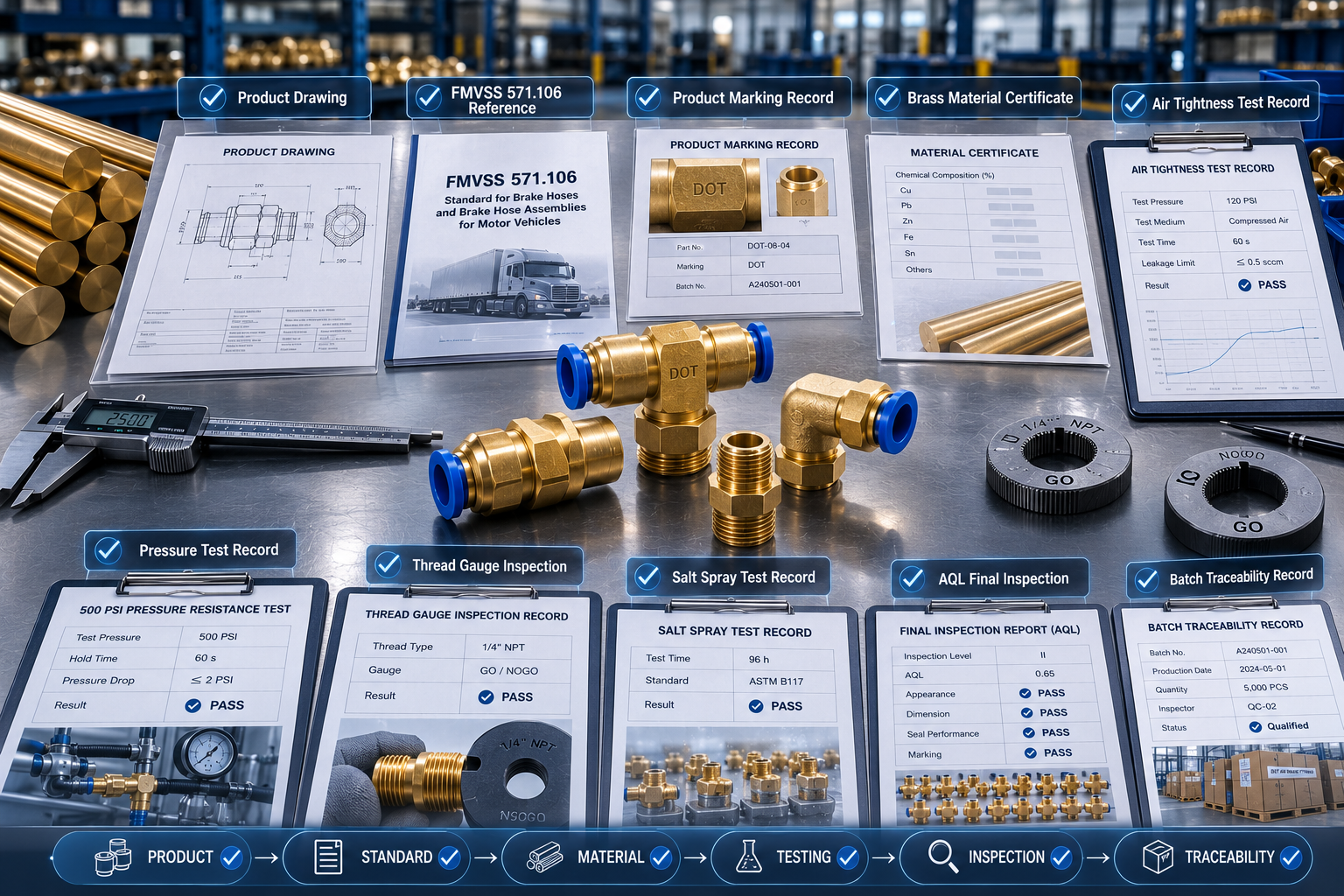
Ordinary brass fittings versus DOT air brake fittings
Not all brass fittings are designed for the same job. Some brass fittings are used in general pneumatic equipment, plumbing accessories, machinery, or low-risk air lines. DOT air brake fittings serve a more controlled application, so buyers should confirm more than the shape.
| Evaluation point | Ordinary brass fitting | DOT air brake fitting |
|---|---|---|
| Application | General fluid or air connection | Air brake system connection |
| Documentation need | Often basic drawing and material | Standard reference, marking, test evidence |
| Thread accuracy[^6] | Important | Critical for sealing and assembly |
| Air tightness | Application dependent | Must be tightly controlled |
| Traceability | May be limited | Strongly recommended for batch control |
| Buyer risk | Usually commercial performance | Safety, compliance, and customer claim risk |
Key product details buyers should confirm
When I review a new RFQ, I usually ask for the following details before confirming production:
- Drawing or sample
- Tube size
- Thread standard, such as NPT
- Part style, such as union, elbow, tee, reducer, plug, or coupling
- Material requirement, such as H59 or H62 brass
- Surface treatment
- Marking requirement
- Testing requirement
- Target market, especially North America
- Packaging and labeling requirement
These details help prevent a common problem: the buyer and supplier may use the same part name but mean different specifications.
Thread precision and sealing performance
In brass air brake fittings, thread quality has a direct effect on assembly and sealing. A thread may look acceptable to the eye but fail a gauge inspection.[^7] That is why thread gauge inspection is a normal quality control step in our production process.
For procurement teams, the important checks include:
- Thread form accuracy
- Thread depth and engagement
- Burr control
- Surface cleanliness
- Consistent machining across batches
I once had a customer send a sample that looked almost identical to our standard DOT fitting. After we measured it, the thread tolerance and sealing contact area were different. That small difference changed how we quoted, tested, and documented the product. This is why I prefer drawings and measurable specifications over catalog pictures alone.
Material control matters
Brass material quality affects machinability, corrosion resistance, and long-term stability.[^8] In our factory, incoming H59/H62 brass bars are checked with batch certificates and material confirmation steps. Buyers should ask suppliers how they control raw material before production, not only how they inspect finished parts.
For truck parts distributors, this matters because inconsistent material can lead to unstable machining, thread defects, sealing problems, or color variation. A stable brass source also helps reduce sudden cost and lead-time surprises.
What Documents Should Buyers Request for DOT Certification for Air Brake Fittings?
Procurement teams often ask for one certificate because they need a fast internal approval. I understand that pressure. However, DOT Certification for Air Brake Fittings is easier to defend when the buyer collects a complete document set tied to the actual product and batch.
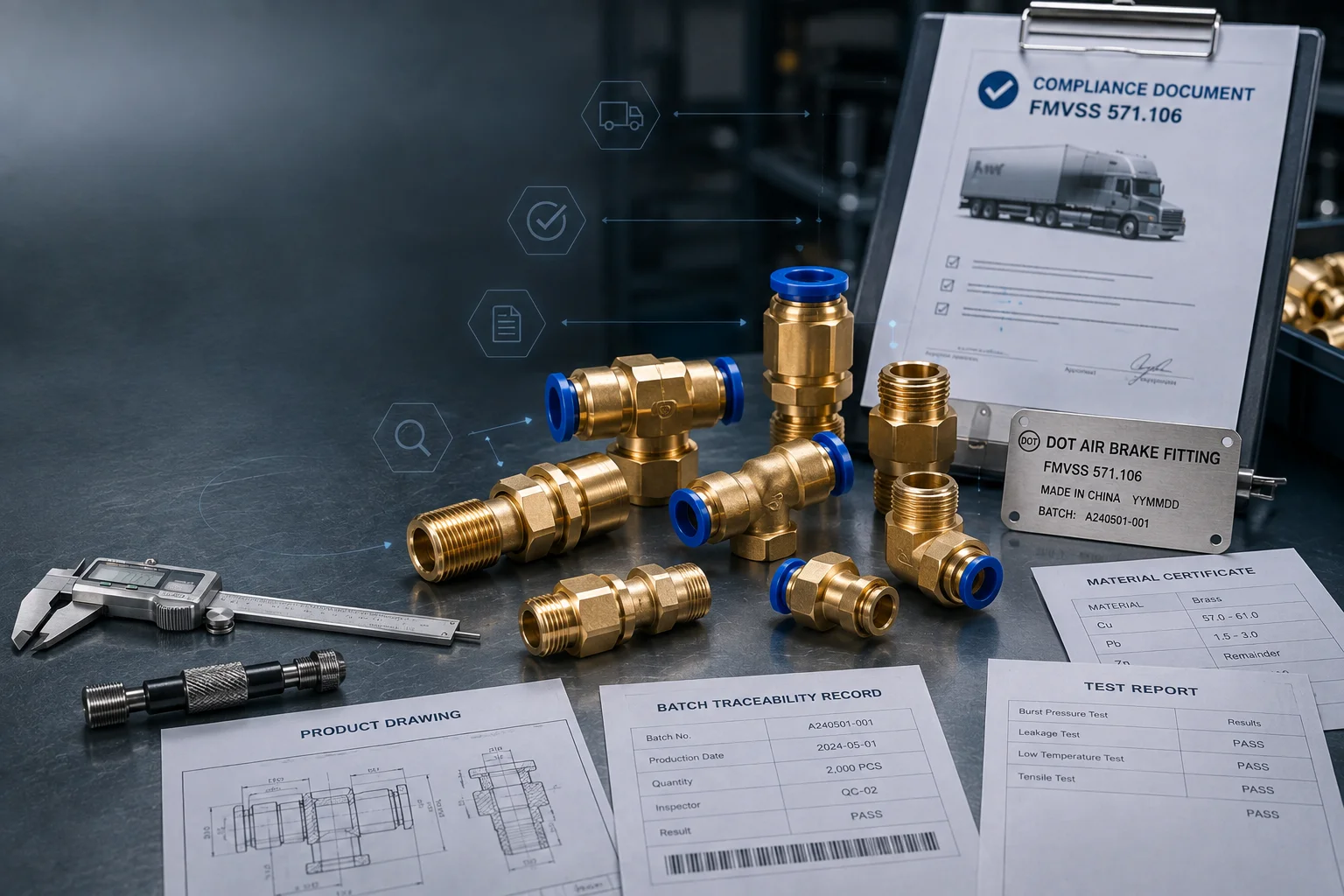
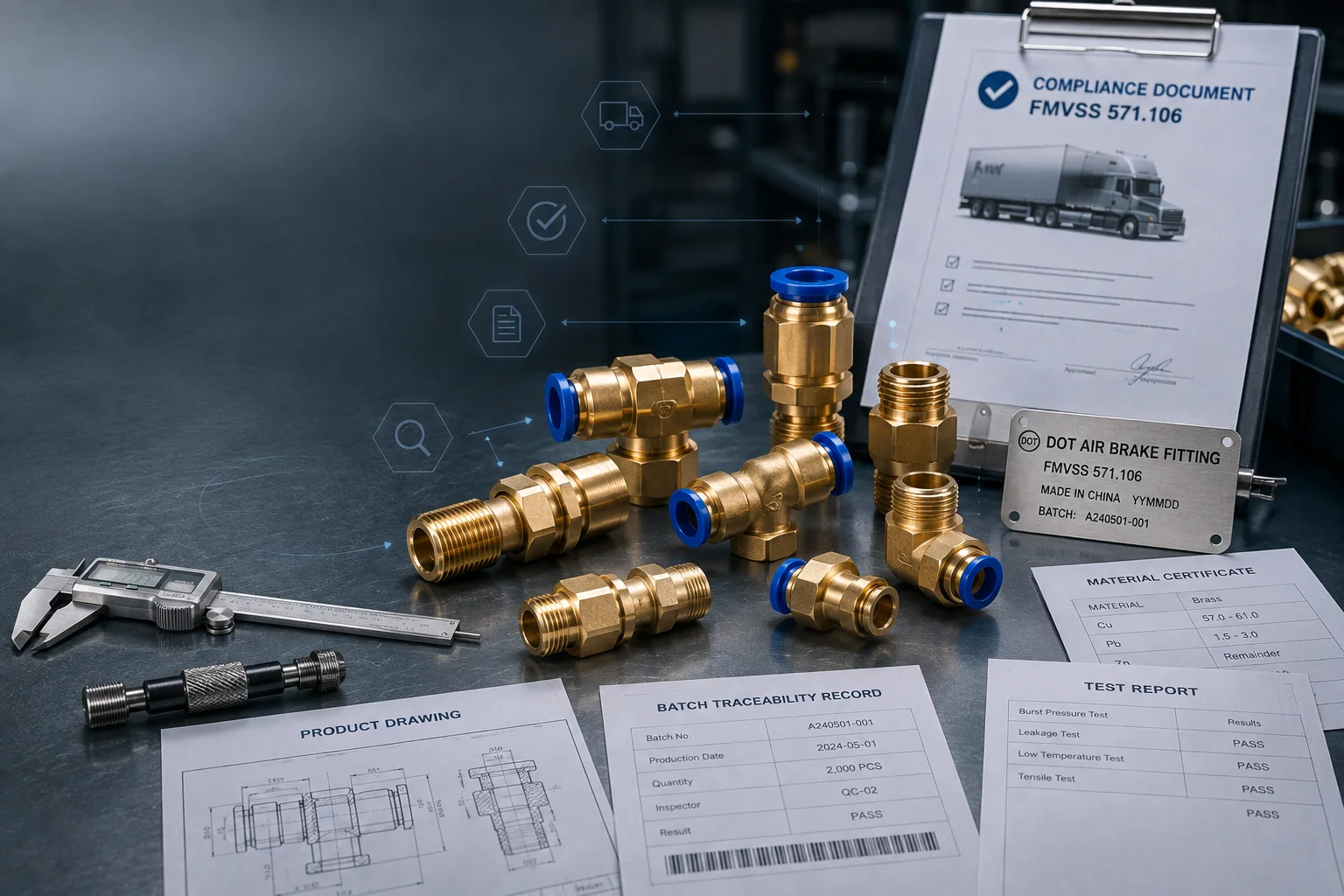
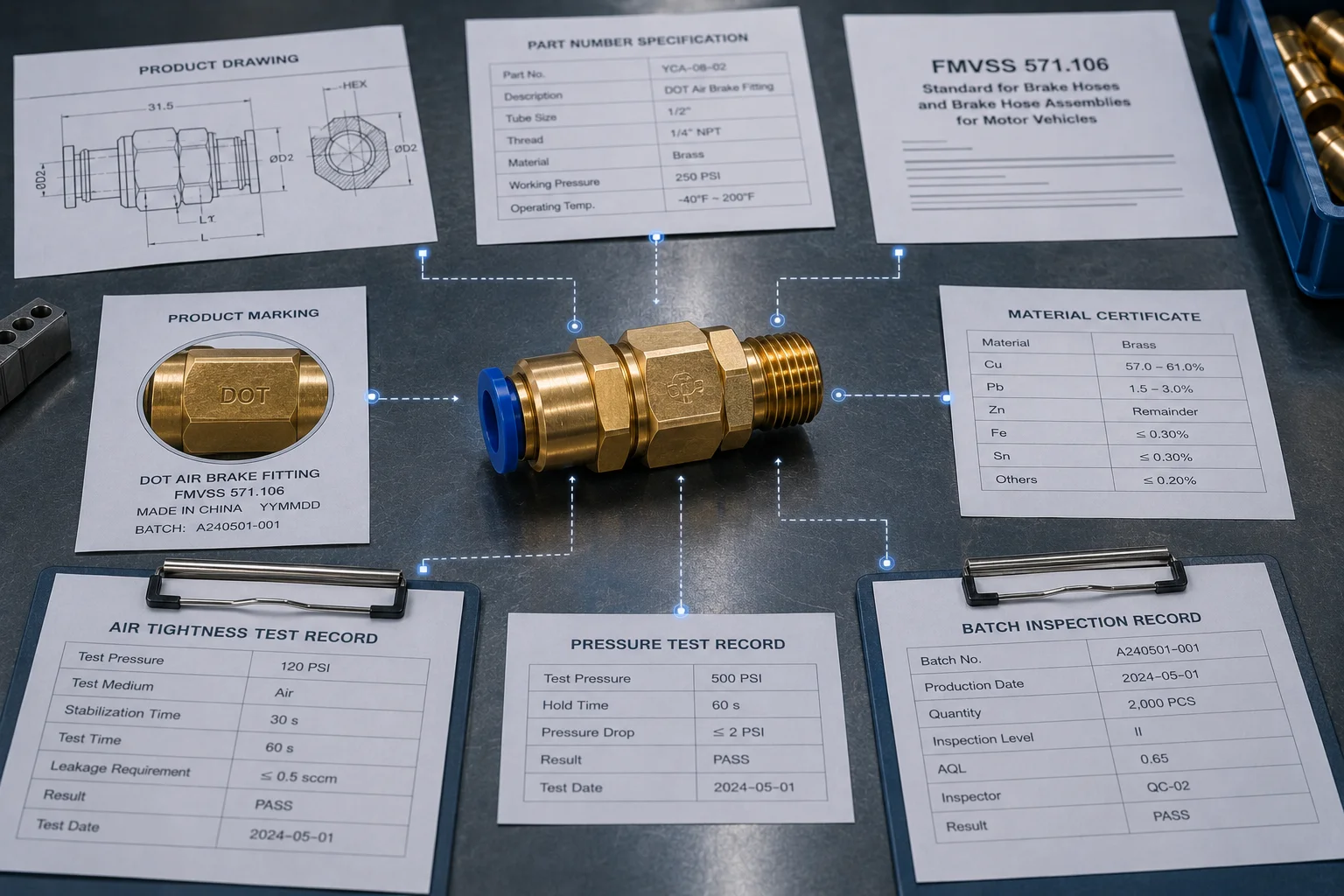
Buyers should request product identification, applicable standard references, marking details, material confirmation, test reports, inspection records, and traceability documents. A one-time certificate or supplier claim should not be the only basis for approving DOT Certification for Air Brake Fittings.
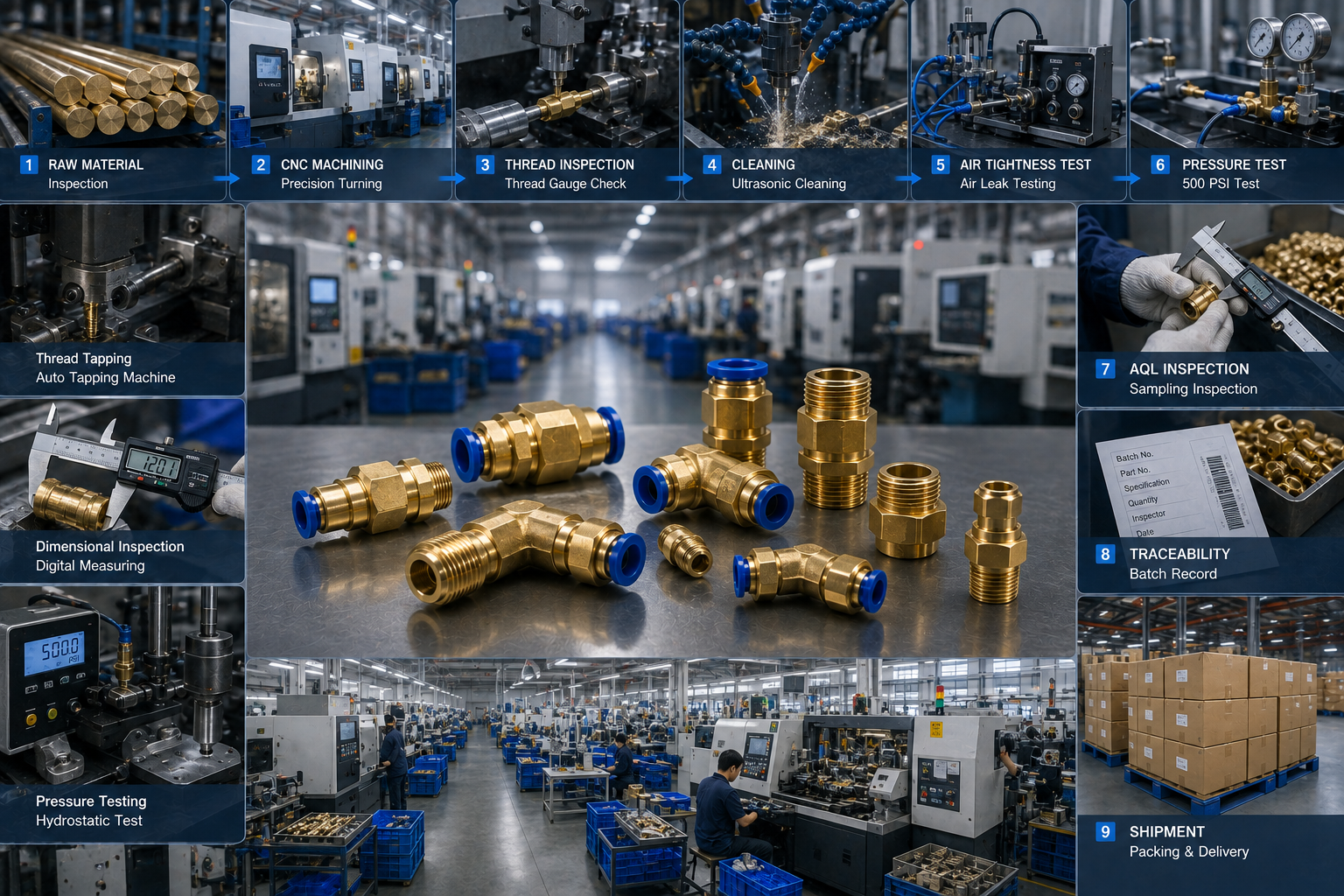
A practical document checklist
I suggest buyers use a checklist like this during supplier qualification:
| Document or record | What it helps verify |
|---|---|
| Product drawing or specification sheet | Confirms dimensions, threads, and structure |
| Applicable standard statement | Connects the product to FMVSS 571.106 / FMVSS 106 where relevant |
| Marking information | Confirms product identification and buyer requirements |
| Material confirmation | Supports brass grade and batch consistency |
| Air tightness test record | Supports sealing performance |
| Pressure resistance test record | Supports performance under defined test conditions |
| Thread gauge inspection record | Confirms thread accuracy |
| Salt spray test record[^9] | Supports corrosion resistance evaluation |
| AQL final inspection report[^10] | Shows batch sampling before shipment |
| Traceability record | Links raw material, production, inspection, and shipment |
This list does not replace official compliance review. It gives buyers a practical procurement framework.
How to review test evidence
A test report is more useful when it includes clear details. Buyers should check:
- Test item or part number
- Test method or standard reference
- Test pressure
- Sample quantity
- Acceptance criteria
- Test date
- Supplier or laboratory identity
- Result summary
- Signature or approval record
In our production, standard inspection can include air tightness testing, 500 PSI pressure resistance testing, thread gauge inspection, and salt spray testing according to customer and product requirements. For application-specific decisions, buyers should confirm whether these tests match their target use, customer standards, and local regulatory expectations.
Why batch records matter more than perfect samples
A beautiful sample can hide weak mass production control.[^11] I have seen buyers approve samples quickly, then worry later about whether the bulk order will match. The better approach is to check how the supplier controls repeatability.
Strong batch control usually includes:
- Incoming material inspection
- First-piece inspection
- In-process sampling
- Tool wear monitoring
- Thread gauge checks
- Air tightness testing
- Final AQL sampling
- Production traceability
For importers and wholesalers, this documentation helps reduce after-sales disputes. It also makes communication easier when a customer asks for proof beyond a catalog page.
How Do Factory Quality Controls Keep DOT Air Brake Fittings Consistent in Bulk Orders?
A supplier can make one good part with careful manual attention. The real procurement question is whether the supplier can make thousands or millions of consistent parts. That is where factory quality control becomes more important than a single sample or one attractive price.
Factory quality controls keep DOT air brake fittings consistent by managing brass material batches, CNC machining accuracy, thread forming, in-process inspection, air tightness testing, pressure testing, final AQL sampling, and traceability from raw material to shipment. Buyers should audit these controls during supplier selection.
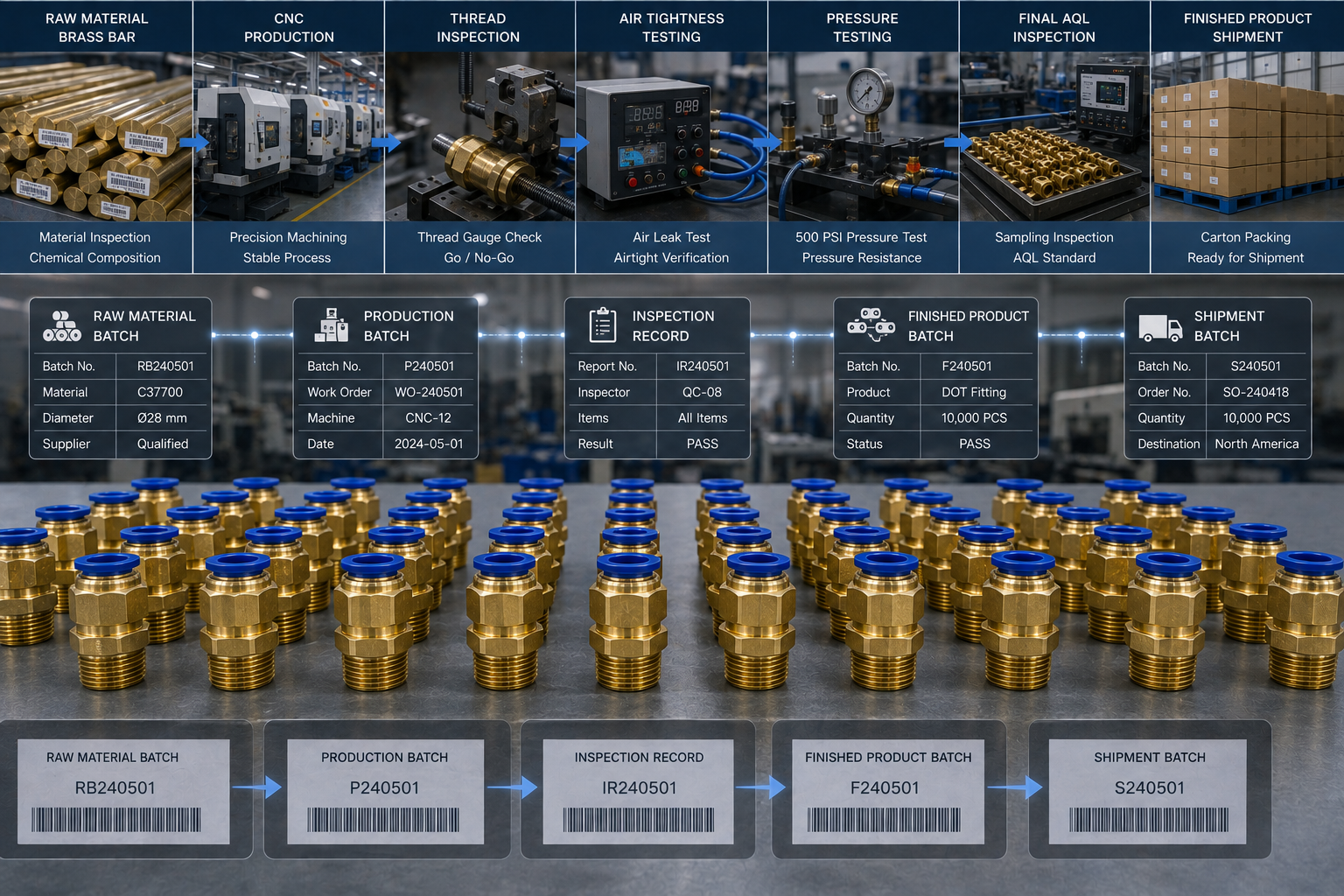
What I look at inside the factory
As a brass fittings manufacturer, I focus on repeatable control points. At Yaochong, our production base uses precision CNC lathes, thread rolling machines, automatic tapping machines, ultrasonic cleaning lines, and surface treatment lines. These capabilities help, but equipment alone is not the full answer. The real value comes from controlled processes.
A practical quality flow looks like this:
-
Raw material incoming inspection
- Brass bar batch certificate checking
- H59/H62 brass confirmation
- Visual inspection for surface issues
-
Machining control
- CNC turning according to drawing
- Dimensional checks
- Tool wear monitoring
-
Thread forming and tapping
- Thread gauge inspection
- Burr control
- Fit and engagement checks
-
Cleaning and surface treatment
- Removal of chips and oil
- Surface finish consistency
- Corrosion resistance support
-
Performance testing
- Air tightness testing
- 500 PSI pressure resistance testing when applicable
- Salt spray testing according to product requirement
-
Final inspection and warehousing
- AQL sampling
- Packaging verification
- Traceability record filing
Why traceability helps buyers
Traceability is not just a factory slogan. It helps buyers respond when something goes wrong. If a distributor receives a quality complaint, traceability helps identify the raw material batch, production date, machine, inspection record, and shipment batch.
This matters for DOT brass air brake fittings because distributors may sell the same part to multiple customer groups. Without traceability, one complaint can become a broad inventory problem. With traceability, the supplier and buyer can review the affected batch more accurately.
How buyers can evaluate supplier reliability
I suggest buyers ask direct questions during supplier screening:
- How do you inspect brass raw material?
- Do you keep batch certificates?
- Which machines produce this fitting?
- How do you control thread accuracy?
- What percentage of parts receive air tightness testing?
- What pressure test can you support?
- Do you follow AQL before shipment?
- Can you provide inspection records with the order?
- How do you handle nonconforming parts?
- Can you support OEM/ODM drawings and custom packaging?
These questions are more useful than asking only for the lowest unit price. A cheaper fitting can become expensive if it causes returns, installation issues, or unclear compliance claims.
For buyers who manage both small mixed orders and bulk container orders, supplier flexibility also matters. Rolling stock, flexible MOQ support, stable lead times, and fast communication can reduce inventory pressure. However, these commercial advantages should sit on top of quality control, not replace it.
Frequently Asked Questions
Is “DOT approved” the same as fully certified for every brake system?
No. I would not treat “DOT approved” as a universal answer. Buyers should confirm the exact fitting, application, FMVSS 571.106 relevance, marking, testing evidence, and customer requirements. Official regulatory interpretation should be verified through DOT/NHTSA texts or qualified compliance professionals.
What is the most important document for DOT air brake fittings?
No single document is enough in every case. I recommend collecting a product drawing, standard reference, marking details, material confirmation, test reports, and batch inspection records. The strongest file connects the actual part number and shipment batch to the supporting evidence.
Can ordinary brass fittings be used in air brake systems?
Buyers should not assume ordinary brass fittings are suitable for air brake systems. Air brake use requires confirmed specifications, sealing performance, thread accuracy, material control, and applicable DOT/FM VSS documentation. The final decision should match the vehicle system and customer requirement.
What tests should I ask a supplier to provide?
Common checks include air tightness testing, pressure resistance testing, thread gauge inspection, material confirmation, salt spray testing, and final AQL inspection. Buyers should confirm test conditions, sample quantity, acceptance criteria, and whether the test matches the intended air brake application.
Why does batch inspection matter if the sample passed?
A sample only proves that one part can be made correctly. Batch inspection shows whether the supplier can maintain stable quality in mass production. For DOT air brake fittings, buyers should review in-process inspection, final AQL records, and traceability before approving repeat orders.
Conclusion
DOT Certification for Air Brake Fittings should be treated as a structured procurement review, not a simple marketing phrase. I recommend checking application suitability, FMVSS 571.106 relevance, product marking, material control, test evidence, and repeatable factory quality records together. This approach helps distributors reduce compliance confusion and bulk order risk. If you are sourcing DOT brass air brake fittings, send your specifications, drawings, target market, and testing requirements. My team can help confirm suitable products and provide relevant documentation support.
[^1]: "Interpretation ID: 22492 - NHTSA", https://www.nhtsa.gov/interpretations/22492. NHTSA explains that manufacturers certify their own compliance with applicable Federal Motor Vehicle Safety Standards, so a generic “DOT approved” statement should not be treated as evidence of official product approval. Evidence role: general_support; source type: government. Supports: NHTSA generally administers FMVSS through manufacturer self-certification rather than issuing blanket product approvals, making unsupported “DOT approved” wording potentially misleading.. Scope note: This supports the regulatory context for skepticism toward the phrase; it does not evaluate any specific fitting or supplier. [^2]: "49 CFR 571.106 -- Standard No. 106; Brake hoses.", https://www.ecfr.gov/current/title-49/subtitle-B/chapter-V/part-571/subpart-B/section-571.106. The federal regulation at 49 CFR § 571.106 is titled Federal Motor Vehicle Safety Standard No. 106, establishing that “FMVSS 571.106” and “FMVSS 106” refer to the same brake-hose standard. Evidence role: definition; source type: government. Supports: The legal citation 49 CFR § 571.106 corresponds to Federal Motor Vehicle Safety Standard No. 106.. [^3]: "49 CFR 571.106 -- Standard No. 106; Brake hoses. - eCFR", https://www.ecfr.gov/current/title-49/subtitle-B/chapter-V/part-571/subpart-B/section-571.106. Federal brake-hose requirements under FMVSS No. 106 distinguish regulated brake hose components and end fittings from general-purpose pneumatic hardware, supporting the article’s distinction between ordinary brass fittings and air-brake fittings. Evidence role: general_support; source type: government. Supports: Brake-system components are subject to specific regulatory and performance requirements, so generic brass fittings cannot automatically be assumed suitable.. Scope note: This provides regulatory context rather than a material-by-material determination of which brass fittings are suitable. [^4]: "49 CFR 571.106 -- Standard No. 106; Brake hoses.", https://www.ecfr.gov/current/title-49/subtitle-B/chapter-V/part-571/subpart-B/section-571.106. The text of 49 CFR § 571.106 states requirements for brake hoses, brake hose assemblies, and brake hose end fittings under Federal Motor Vehicle Safety Standard No. 106. Evidence role: definition; source type: government. Supports: The standard’s stated scope includes brake hoses, brake hose assemblies, and brake hose end fittings.. [^5]: "49 CFR 571.106 -- Standard No. 106; Brake hoses. - eCFR", https://www.ecfr.gov/current/title-49/subtitle-B/chapter-V/part-571/subpart-B/section-571.106. FMVSS No. 106 includes performance and identification requirements for brake hoses, brake hose assemblies, and end fittings, supporting the need to evaluate a fitting against its intended brake-system application. Evidence role: general_support; source type: government. Supports: FMVSS 106 contains performance and labeling or marking requirements that make application-specific design, testing, and identification relevant to compliance review.. Scope note: The regulation supports the need for application-specific verification; it does not prescribe the article’s full supplier-screening workflow. [^6]: "Selecting the right thread gage", https://www.aerospacemanufacturinganddesign.com/article/selecting-the-right-thread-gage/. Technical standards for screw and pipe threads define thread form, tolerances, and gauging because these dimensions control fit, engagement, and sealing behavior in threaded joints. Evidence role: mechanism; source type: institution. Supports: Thread form, pitch, and engagement influence fit and sealing performance in threaded connections.. Scope note: The source would support the general engineering mechanism; it may not test the specific brass air brake fitting designs discussed in the article. [^7]: "Internal Part Thread Inspection - Quality Magazine", https://vermontgage.com/support/detail/internal-part-thread-inspection-quality-magazine. Thread-gauging standards and metrology guidance treat gauges as dimensional verification tools for screw threads, supporting the point that visual appearance alone is insufficient to confirm thread conformity. Evidence role: mechanism; source type: institution. Supports: Thread gauges are used to verify dimensional conformity that cannot be reliably confirmed by unaided visual inspection.. Scope note: This supports the inspection principle, not a documented failure rate for the article’s specific fittings. [^8]: "Brass Grades & Their Uses: A Deep Dive Into the Golden ...", https://crmetals.net/brass-grades-and-their-applications-a-deep-dive-into-the-golden-alloy/. Materials references on copper-zinc brasses describe how alloy composition and condition influence machinability and corrosion resistance, supporting the article’s claim that brass quality affects production stability and service behavior. Evidence role: mechanism; source type: research. Supports: Brass alloy composition and quality influence machining behavior and corrosion performance.. Scope note: This is general materials support and does not verify the specific H59 or H62 batches mentioned in the article. [^9]: "Salt spray test", https://en.wikipedia.org/wiki/Salt_spray_test. Standardized salt spray methods such as ASTM B117 and ISO 9227 provide controlled accelerated corrosion exposures, making salt spray records relevant to corrosion-resistance evaluation. Evidence role: general_support; source type: institution. Supports: Salt spray tests are standardized accelerated corrosion exposure methods used to compare corrosion performance under defined laboratory conditions.. Scope note: Salt spray results are comparative laboratory data and do not directly predict exact field service life. [^10]: "Acceptable Quality Limit, AQL", https://www.qima.com/aql-acceptable-quality-limit. Acceptance-sampling standards such as ISO 2859-1 define AQL-based lot inspection procedures, supporting the use of AQL reports as evidence of batch sampling before shipment. Evidence role: definition; source type: institution. Supports: AQL-based inspection is a standardized acceptance-sampling approach for evaluating production lots.. Scope note: AQL sampling estimates lot acceptability and does not guarantee that every individual part is conforming. [^11]: "Quality Control in Manufacturing: Overview and Best ...", https://www.6sigma.us/manufacturing/quality-control-in-manufacturing/. Quality-management standards such as ISO 9001 emphasize process control, monitoring, and verification of product conformity, supporting the view that a single approved sample is insufficient evidence of stable mass-production quality. Evidence role: expert_consensus; source type: institution. Supports: Quality management standards emphasize controlled production processes, monitoring, and inspection rather than relying only on isolated samples.. Scope note: This supports the general quality-management principle, not a quantified defect risk for air brake fittings.